




























Best places to park idle business cash in the UK (2026)
 Copied!
 A neutral, ranked look at the nine realistic homes for UK idle business cash in 2026, from FSCS-protected deposit platforms to money market funds, so you can choose by how much you hold and how much automation you want.
UK businesses have three meaningful routes for idle cash in 2026: a savings account opened directly with a bank, a deposit platform that spreads cash across dozens of banks, or a money market fund.
TL;DR
- The right route depends on how much you hold, how often it needs to move, and how much time you want to spend managing it.
- Nine options are ranked and compared side by side.
- A full comparison table covers yield, protection and minimums.
- There is a section on how we would choose, rather than a list with no view.
How to think about idle business cash
Before you compare rates, it helps to understand the three structural routes and what you are actually trading.
Route 1: A savings account opened directly with a bank
You open a business savings account with a bank or building society yourself, choosing instant access, notice, or fixed term. Simple, familiar, one relationship to manage.
Eligible deposits are protected by the FSCS up to £120,000 per authorised bank. Note that limit is per banking licence, not per brand: where a group runs several brands on one licence, they share a single £120,000 limit. The rate ceiling is wherever bank deposit rates sit. As of June 2026, the best business savings rates have been running around 4.3% AER. The catch is that coverage stops at £120,000 unless you open accounts at several banks and manage each one yourself.
Route 2: An FSCS deposit platform
A platform such as Flagstone, Insignis, or Akoni spreads your cash across a network of FCA-regulated banks. You complete KYC once and place money through a single dashboard, and because each bank holds a separate deposit, FSCS coverage extends across the network rather than stopping at one institution's limit.
Same risk model as Route 1 and broadly the same rate ceiling, minus the platform's interest margin. What you are buying is coverage at scale without ten separate bank relationships. Minimums are higher: Flagstone's business entry point is £100,000.
Route 3: Money market funds (MMFs)
An MMF pools your cash with other investors and buys short-term, high-quality instruments: government bills, bank paper, top-grade corporate debt. The yield tracks the market more closely than bank deposits, which is why MMF yields have often run ahead of savings rates in a higher-rate environment.
The key distinction: MMFs are not bank deposits. They are regulated investment products. Your money is held in segregated assets, so a provider failure does not put client cash on the balance sheet, but the underlying instruments carry their own credit risk, and the value of your investment can fall. FSCS deposit protection does not apply to the fund itself. The phrase to know is "asset protection, not FSCS."
For most high-quality sterling MMFs (BlackRock ICS, Fidelity, J.P. Morgan AM), the funds are designed to maintain a stable net asset value and have a strong track record of doing so. But this is a different risk model from a deposit, and capital is at risk in a way it is not with an FSCS-protected account. Understand that before choosing.What to weigh before deciding
The ranked list: 9 options compared
The nine options below represent the realistic shortlist for a UK business in 2026. They are not ranked purely by yield, because yield is only one variable. They are ordered roughly from "most protection-focused" to "most yield/ops-integration-focused" so you can scan the list in the direction that matches your priorities.
1. Flagstone
What it is: A UK cash deposit marketplace. You sign up once, complete KYC, and then access a menu of instant-access, notice, and fixed-rate savings accounts across 40-plus FCA-regulated partner banks. A holding account (HSBC) sits behind the platform.
Typical yield (2026): Fixed 12-to-24-month accounts have been showing around 4.30% to 4.40% AER on the business platform (rates from flagstoneim.com/business, fetched June 2026). Instant-access rates for personal savers have been advertised up to around 4.20% AER. Rates displayed are net of Flagstone's interest margin.
Protection model: FSCS-eligible per partner bank, up to £120,000 per banking group. Spreading across many banks is the core value proposition. All partner banks are FCA-regulated.
Minimum (business): £100,000. There is no published maximum.
Who it suits: Companies and organisations with a large lump sum, typically £100k or more, that want FSCS coverage at scale without managing 10 separate bank relationships. Charities, property firms, and businesses that sit on significant working capital for months at a time.
Where it fits: If protecting capital across FSCS is your primary goal and you have £100k or more to place, Flagstone is hard to beat on simplicity and coverage. It is a passive tool: money sits, it earns, it does not move or do anything else. You cannot pay a supplier from it.
2. Insignis Cash
What it is: A deposit marketplace and managed cash service, operated by Insignis Asset Management Limited (FCA-regulated).
Similar model to Flagstone: spread deposits across a network of partner banks, one KYC, one dashboard.
Insignis adds a designated account manager service to guide clients on where to place and when to switch.
Worth knowing: Insignis is also the deposit-spreading partner behind Round's own Savings product, so choosing Insignis directly versus Round's Savings option is largely a question of whether you want the extra automation, AP, and payroll Round layers on top, rather than a different underlying bank network.
Typical yield (2026): Bank deposit rates, which track the current savings market. Insignis does not publish a standard rate table publicly in the same way as Flagstone; rates are competitive with the deposit market. Check insigniscash.com/business-savings for current offers.
Protection model: FSCS per partner bank, same mechanism as Flagstone.
Minimum: Not publicly confirmed. Contact Insignis directly. The platform is positioned for companies, charities, trusts, and local authorities, which suggests a meaningful minimum.
Who it suits: Businesses and organisations that want FSCS-spread deposits and value human support in managing placement: finance teams that would rather have a conversation than work a dashboard.
Where it fits: Very similar to Flagstone in structure; the main differentiator is the account-manager relationship and the client types it specifically courts (charities, trusts, local authorities alongside companies). If managed service matters, Insignis is worth a direct conversation.
3. Akoni Cash Management
What it is: A savings platform for businesses and individuals, offering instant-access, notice, and fixed-rate accounts across multiple providers including Investec, Aldermore, Barclays, and Charter Savings Bank.
Typical yield (2026): Bank deposit rates, in line with the savings market. Specific rates vary by the partner banks on offer, so check current rates with the provider.
Protection model: FSCS-eligible per partner bank.
Minimum: Not publicly confirmed. Contact Akoni directly.
Who it suits: SMEs that want a straightforward multi-bank deposit spread without a high entry point or managed-service overhead.
Where it fits: Akoni is consistently named alongside Flagstone and Insignis in UK comparison sources as a third business deposit platform. Fewer public details are available than for Flagstone. If the others do not fit your size or you prefer a different provider mix, Akoni is worth investigating.
4. Direct business savings accounts
What it is: Opening a savings account directly with a bank or building society. Providers in the UK business savings market include Cambridge and Counties Bank, Redwood Bank, Allica Bank, Tide, Hampshire Trust Bank, Shawbrook, and United Trust Bank, among others.
Typical yield (2026): The best business savings rate as of mid-June 2026 was approximately 4.3% AER (source: moneyfactscompare.co.uk). Aggregator sites such as money.co.uk have advertised rates up to 4.4%. Rates vary significantly by account type (instant access, notice, fixed) and by provider.
Protection model: FSCS, up to £120,000 per banking group for eligible businesses.
Minimum: Varies by provider and account type, from a few hundred pounds to tens of thousands.
Who it suits: Businesses that want the simplest possible setup, are comfortable with one bank relationship, and hold under £120k (or are comfortable with single-institution concentration above that). Also suits businesses that want to keep everything inside an existing banking relationship.
Where it fits: The highest-rate direct savings accounts are often smaller, specialist banks you may not have heard of. The headline rates are competitive with deposit platforms but you are managing the relationship yourself, and you lose the spreading benefit unless you open multiple accounts.
5. TreasurySpring
What it is: A wholesale-grade cash platform offering Fixed-Term Funds (FTFs). Each FTF gives you maturity-matched exposure to a single investment-grade issuer, covering government bills, bank deposits, and corporate paper. Terms run from one week to one year; currencies include GBP, USD, EUR, and more. There are over 1,000 products across eight currencies.
Typical yield (2026): Money-market-style yields that reflect the specific issuer and term chosen. Rates are not published as a headline figure; they depend on which FTF you select and when. Check treasuryspring.com for current offers.
Protection model: Not standard FSCS. Credit risk sits with the chosen counterparty (the issuer of the FTF), not with TreasurySpring as a platform. All obligors are investment-grade. There is no "run risk" in the way an open-ended MMF can face one, because each FTF is fully maturity-matched: your investment and the underlying asset settle on the same date. This is a different and arguably more transparent risk model than a pooled MMF, but it is explicitly not FSCS-covered deposit protection.
Minimum: TreasurySpring is understood to have a substantial minimum; figures are not publicly confirmed and should be verified directly. The platform is designed for corporates, SMEs, family offices, and charities with meaningful treasury balances.
Who it suits: Finance teams that want institutional-grade, risk-tiered cash management with clear visibility of exactly what they are exposed to, and who are comfortable moving beyond the standard deposit/MMF binary.
Where it fits: TreasurySpring is the most sophisticated option on this list for companies that want to actively manage the credit quality and duration of their cash portfolio. It requires more active attention than a deposit platform and is not for cash you need to access unpredictably. Verify the minimum directly before considering it.
6. Wise Interest
What it is: Wise holds your balance in an interest-bearing product that invests in money-market-style assets. Available as part of the Wise multi-currency business account.
Typical yield (2026): GBP interest of around 3.23% variable (as of late March 2026, per Bloomberg reporting). Rates are variable and will move with the market.
Protection model: MMF-style asset protection, not FSCS. Wise is regulated by the FCA and safeguards client funds, but the mechanism is asset protection, not deposit insurance.
Minimum: Low. The product is accessible to Wise Business account holders without a large minimum balance requirement.
Who it suits: SMEs that are already using Wise for multi-currency payments and FX, and want to earn something on GBP or other currency balances without moving money to a separate platform.
Where it fits: The GBP yield trails the best business savings accounts and deposit platforms on this list. The value case is convenience: if you already move money internationally through Wise, keeping a working balance earning yield there makes sense. It is not the highest yield option.
7. Revolut Business Flexible Cash Funds
What it is: A feature within Revolut Business that lets you invest spare company cash into Fidelity money market funds (available in GBP, EUR, and USD). Yield accrues daily and the aim is capital preservation.
Typical yield (2026): Variable, tracking MMF market rates. The exact GBP yield is not confirmed in our research at time of writing. Check Revolut Business directly for current rates.
Protection model: MMF protection, not FSCS. Your money is in regulated investment funds, not a bank deposit.
Minimum: Low. Accessible to Revolut Business account holders.
Who it suits: Revolut Business users who want to earn yield on idle balances without leaving the Revolut platform. If your team uses Revolut for cards, expenses, and FX, parking surplus cash in Flexible Cash Funds requires zero extra onboarding.
Where it fits: Like Wise, the convenience case is strong if you are already on Revolut Business. The product does not offer the integration depth or automation that a treasury-first platform provides, and the GBP yield needs to be confirmed against current alternatives before assuming it is competitive.
8. Airwallex Yield
What it is: Launched March 2026, Airwallex Yield routes idle cash into a J.P. Morgan AM government money market fund. Available to Airwallex business account holders. There is no lock-up period.
Typical yield (2026): Up to 3.40% APY on idle USD (since March 2026, per Airwallex's own blog). The GBP yield figure is not confirmed in our research at time of writing. Check airwallex.com directly for current GBP rates.
Protection model: MMF protection, not FSCS. No lock-up.
Minimum: Low. Available to Airwallex account holders.
Who it suits: Scaling businesses that use Airwallex for global payments and multi-currency operations, and want to earn yield on their operating cash without a separate treasury setup.
Where it fits: Airwallex is a genuinely broad platform (cards, expense, AP, FX, and now yield), which makes it relevant for companies that want operational breadth alongside treasury. If your business operates globally with complex multi-currency needs, Airwallex is one of the stronger all-in options. The GBP yield should be verified before comparison.
9. Round
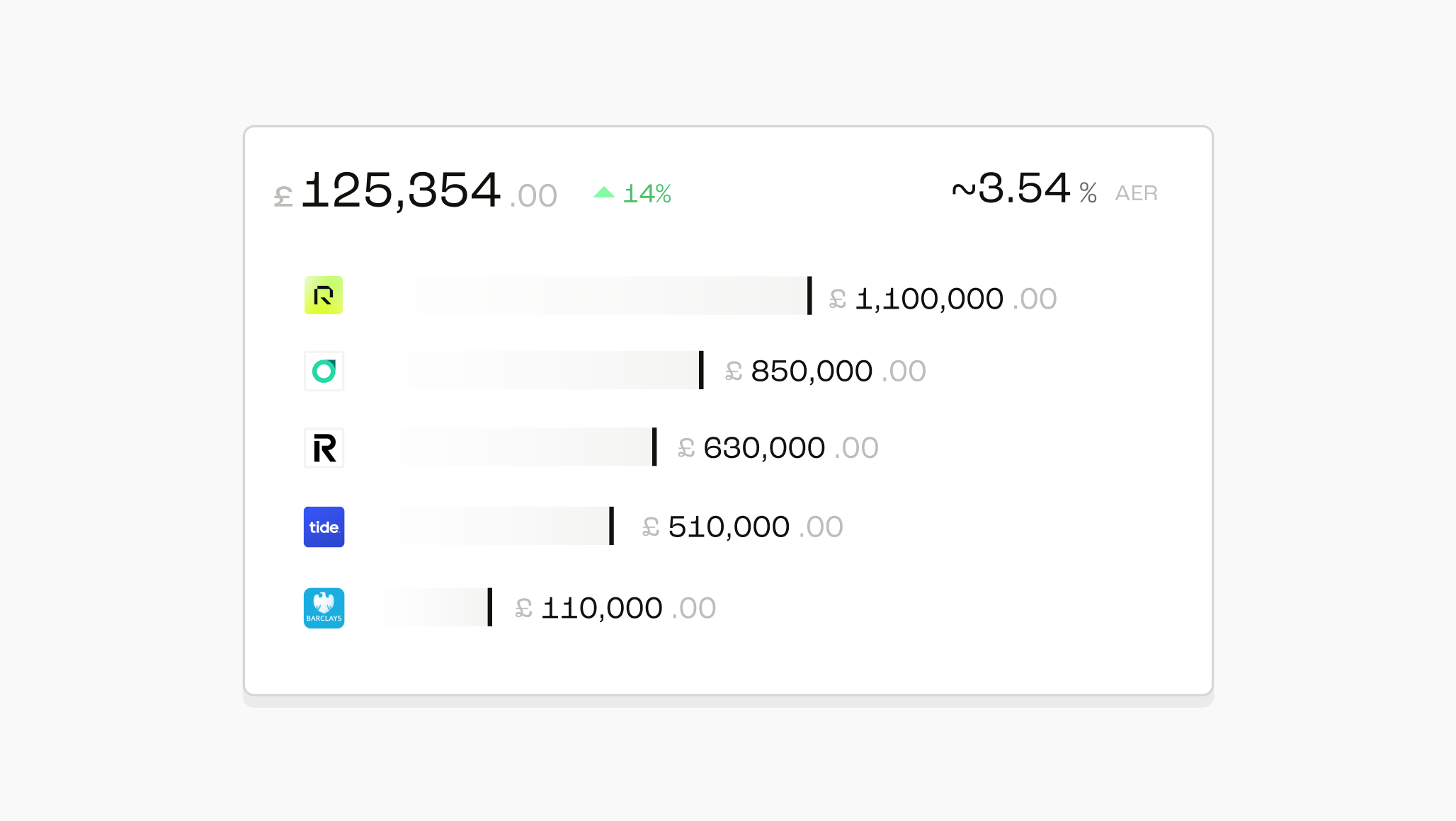
What it is: Round is a UK finance automation platform that sweeps idle cash into the BlackRock ICS Sterling Liquidity Fund (a AAA-rated institutional money market fund) as part of a broader system that also handles accounts payable, UK payroll, multi-entity cash visibility, and FX. You do not need to manage the sweep manually: Round handles the cash movement and can fund your payment runs directly from your treasury balance.
Typical yield (2026): Round's claim is "4x average yield on idle cash versus a standard business savings account" (roundtreasury.com), reflecting the net daily yield from the BlackRock ICS Sterling Liquidity Fund. Round doesn't publish one fixed rate: net AER varies by plan tier and loads live on the pricing page, moving with the money market, so check roundtreasury.com/pricing for the current figure rather than a number printed in a comparison article.
Protection model: Round offers two routes. Its Savings product (via Insignis) provides FSCS-protected deposits spread across UK partner banks, up to £120,000 per institution and up to £3.5m in aggregate, the same model as Flagstone. Its money market route (the BlackRock ICS Sterling Liquidity Fund) is asset protection, segregated and institutional-grade, not FSCS, and your capital is at risk. Round holds customer assets in segregated accounts with regulated partners, including BlackRock as fund manager, and does not hold customer money on its own balance sheet.
Minimum: Contact Round directly. Not publicly confirmed on the site.
Who it suits: Finance teams, founders, and CFOs at growing UK companies that want yield on idle cash but also need to automate how that cash moves: paying suppliers, running payroll, managing multiple entities. If you are currently keeping cash in a low-yield bank account because moving it feels like admin, Round is designed for that problem. The platform connects to Xero and NetSuite, so payments reconcile automatically.
Where it fits: Round is not the right choice if your sole objective is the highest FSCS-protected rate and you have no interest in automating your finance operations, though its own Savings product can meet the FSCS need if you'd rather stay on one platform. Round is the right choice if you want MMF-grade yield and you also want to stop doing manually what a system should do: fund a payroll run from your treasury balance, auto-code and pay invoices, and see all your cash in one place.
Comparison table
How we would choose
There is no single right answer, so here is how we think through it by situation.
You have a large lump sum to protect
If you are sitting on £500k or more and your priority is FSCS coverage at scale with competitive rates, Flagstone or Insignis are built for exactly this. Flagstone's £100k business minimum and 40-plus bank network gives you meaningful spread. Insignis adds a managed-service layer if you want guidance on placement. These are passive tools: the money earns, it does not move, and that is the point.
You want the highest available yield on a deposit
Check the direct business savings market at moneyfactscompare.co.uk or money.co.uk. As of June 2026, the best business rates have been around 4.3% AER. The catches: you manage a direct relationship yourself; FSCS covers only £120k per institution; and fixed-term accounts tie up liquidity. Deposit platforms such as Flagstone shave a small margin but handle the relationship management for you.
You already use a fintech for payments and want effortless yield
If you are already on Wise, Revolut Business, or Airwallex, the path of least resistance is enabling their yield products and earning on your working balance without opening a separate account. The yields are competitive with, or slightly below, the best deposit platforms, and the convenience trade is real. Just be clear you are in MMF territory, not FSCS territory, for these products.
You want institutional-quality yield with explicit credit-risk control
TreasurySpring is for finance teams that want to know exactly what paper they hold, choose the issuer and duration, and actively manage the credit profile of their cash book. This requires more active attention and a meaningful balance. If that matches your setup, it is worth a conversation.
You want yield and you also want to stop managing your finance function manually
This is where Round sits. If you are currently keeping cash idle in a low-rate account because sweeping it somewhere better feels like one more thing to manage, or if you are running payment approval by forwarding emails and chasing people on WhatsApp, Round addresses both at once.
The BlackRock ICS Sterling Liquidity MMF generates yield daily; the platform handles invoice capture, approval routing, payroll funding, and reconciliation to your accounting system. The treasury yield is MMF-grade, not FSCS-protected deposit (Round's separate Savings product covers that need if it matters more to you), so understand the difference before you move cash.
If the "idle cash" problem and the "too much manual finance work" problem are the same problem for you, they can be solved together.
Related reading
- Round vs Flagstone: which is right for your business cash?: a direct comparison of the deposit-marketplace and treasury-automation approaches.
- How Round's treasury works: the mechanics of the BlackRock ICS Sterling Liquidity Fund integration and how same-day liquidity works.
- Round pricing: current tier features and a breakdown of what each plan includes.
- Jack and Jill case study: how one company moved from 0.65% at Tide to 3.85% net yield and automated their payment runs.
Explore Round
If you are holding idle business cash in a low-rate account and want to understand what an automated treasury setup would look like for your business, you can get started at roundtreasury.com.
Frequently Asked Questions
The best yield available depends on what type of protection and liquidity you need. For FSCS-protected deposits, the top business savings rates have been around 4.3% AER (as of June 2026) from specialist providers, or you can access similar rates across multiple banks through deposit platforms like Flagstone (£100k business minimum). For money market fund products, yields vary by provider and track short-term market rates. Round's treasury product, backed by the BlackRock ICS Sterling Liquidity Fund, claims "4x vs standard business savings" (as of Round's own published data, and shown live on Round's pricing page). TreasurySpring offers institutional-grade, risk-tiered access. The important thing is to compare like-for-like: deposit rates are FSCS-protected; MMF yields are not.
High-quality, sterling MMFs (such as those from BlackRock, Fidelity, and J.P. Morgan AM) are generally designed to maintain a stable net asset value and invest only in short-term, high-quality assets. They are regulated and well-established instruments used by large corporations and institutions to manage cash. The key distinction from a bank deposit is that they are not FSCS-covered: your protection comes from the quality of the underlying assets and their segregated structure, not from a government guarantee. For the vast majority of businesses using a AAA-rated sterling MMF, the practical risk is very low, but it is a different risk model from a deposit and should be understood as such.
Eligible UK businesses can claim FSCS protection on bank deposits up to £120,000 per banking group. This is per institution, not per account, so a business holding £500,000 at a single bank would have £120,000 covered and £380,000 unprotected. Deposit platforms such as Flagstone, Insignis, and Akoni solve this by spreading money across multiple banks, each eligible for its own £120,000 protection, and can extend cover up to roughly £3.5m in aggregate once spread across enough banks. Money market fund products (Wise, Revolut Flexible Cash Funds, Airwallex Yield, Round's MMF) are not bank deposits and are not covered by FSCS. FSCS eligibility for businesses also depends on company type and size, so verify your own position with the relevant provider.
Flagstone's published minimum for business clients is £100,000. There is no published maximum. The personal platform has a lower minimum of £10,000, but business and personal products are separate. If your business holds less than £100,000 in idle cash, direct business savings accounts or lower-minimum fintech products (Wise, Revolut, Round) are more accessible starting points.
With most deposit platforms and business savings accounts, the answer is no: the money sits in savings and you transfer it back to your operating account when you need to pay someone. With some integrated fintech platforms, you can do both. Round, for example, holds your cash in a money market fund and can draw from that balance to fund approved supplier payments and payroll runs directly, without you first moving the money to a current account. Airwallex, as a multi-purpose platform, also integrates payments with its Yield product. The integration depth varies significantly, so ask each provider specifically how funds move from yield account to payment.
Most sterling MMFs, including the BlackRock ICS Sterling Liquidity Fund used by Round, offer same-day or next-day liquidity on requests made before a cut-off time (Round states requests by 10:30am settle by end of day). Revolut Flexible Cash Funds and Airwallex Yield also aim for rapid access with no lock-up. This compares favourably to notice accounts (typically 30, 60, or 95 days) and fixed-term deposits (locked for the full term). TreasurySpring FTFs are maturity-matched, meaning funds are available on the chosen maturity date, not on demand.
A deposit platform (Flagstone, Insignis, Akoni) is a tool for placing cash across multiple banks to optimise yield and FSCS coverage. The money is passive: it earns, and that is what the platform does. A treasury platform (Round) is an active system that manages how money moves through your business, including where it sits when it is idle. Round handles cash sweeps, invoice payment, payroll funding, multi-entity visibility, and accounting reconciliation in addition to yield. You should think of deposit platforms as a product and treasury platforms as part of your finance operating infrastructure.
Not necessarily, but you do need to choose a primary approach. If FSCS protection is your non-negotiable, you should use a deposit-based route (direct savings accounts, Flagstone, Insignis, Akoni, or Round's own Savings product) and accept that yields will be at bank deposit market rates, currently around 4.3% at the top of the market. If you are comfortable with a well-regulated MMF's risk model, which most corporate finance teams are for operational cash, you can access MMF yields via fintech platforms, which may offer greater convenience and, in some cases, higher net yield. Some platforms, including Round, offer access to both routes, which means you can mix approaches based on the portion of cash, its likely duration, and your own risk parameters.