






























Cash Position, 13-Week Forecast and Runway: One Control for UK Scale-Ups in 2026
 Copied!
 Start with reconciled cash available today, roll it through dated receipts and payments, then translate the resulting scenarios into the time available before a funding or cost decision becomes unavoidable.
Manage cash position, a 13-week forecast and runway as one finance control, not three dashboards. Start with reconciled cash available today, roll it through dated receipts and payments, then translate the resulting scenarios into the time available before a funding or cost decision becomes unavoidable.
Each view answers a different question. Cash position shows what is usable now. The 13-week forecast shows when pressure appears. Runway shows how long the plan remains financeable under stated assumptions.
TL;DR
- Use one reconciled opening cash figure for the position, forecast and runway model.
- Separate cleared cash from restricted, trapped, uncleared or approval-dependent amounts.
- Build the 13-week view from dated receipts and payments, not monthly profit.
- Calculate runway from scenarios after preserving the minimum operating reserve.
- Give every material assumption an owner, confidence level and next review date.
What decision should these three numbers support?
The common decision is simple: what can we safely commit to now, what must wait and when must the board act? A balance, forecast or runway number is useful only if it changes an approval, collection, spending or funding decision.
The starting definition needs discipline. IAS 7 states: “Cash comprises cash on hand and demand deposits.” It also distinguishes short-term, highly liquid cash equivalents from investments whose value or access is less certain.
Today’s cash position, the 13-week forecast and runway scenarios answer different questions. They should share one opening figure so that a change in expected cash flows reaches the longer-term decision instead of disappearing between dashboards.
Build one control, not three dashboards
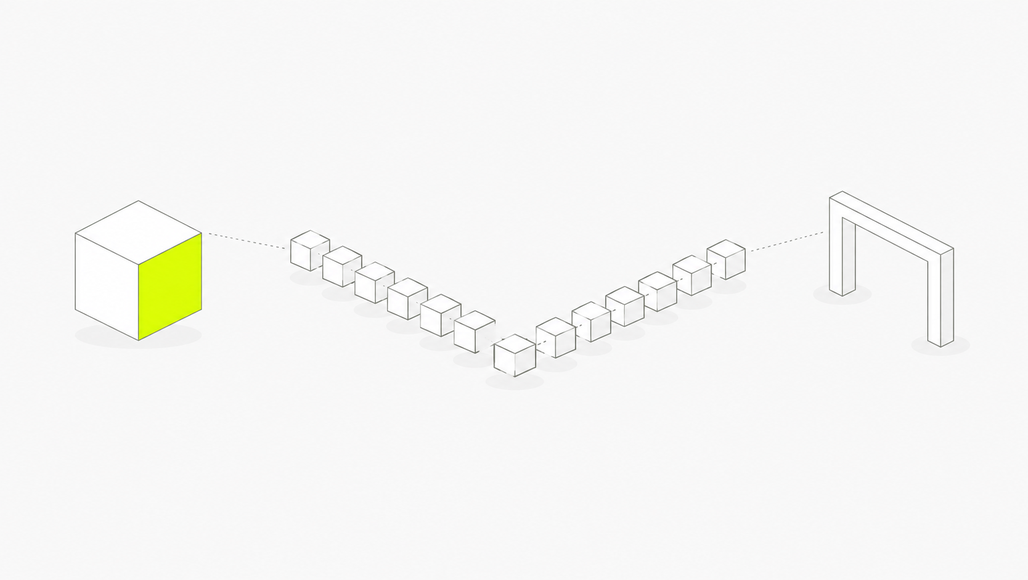
Create a single cash-control record with one opening position, one calendar and one assumptions log. Every output should trace back to the same bank balance, ledger item, contract, tax date or approved management assumption.
A practical control record contains:
- Opening cash: cleared balances by legal entity, bank and currency.
- Availability status: usable, restricted, trapped, uncleared or pending approval.
- Dated cash flows: receipts and payments on expected settlement dates.
- Committed obligations: payroll, tax, debt service, rent and approved capital spend.
- Scenario variables: collection delays, hiring dates, growth spend and funding timing.
- Minimum reserve: the amount management will not plan below.
- Ownership: a named person, confidence level and review date for each assumption.
ICAEW says a cash flow forecast estimates the timing and amounts of cash coming in and out over a specific period. Put receipts into the week when cash is expected to reach the bank, rather than the month when revenue is booked.
The UK Government's financial modelling guidance calls for a bottom-up model with key revenue and cost drivers plus an assumptions log explaining each input's source, logic and rationale. That is the right standard for this control.
What belongs in the daily cash position?
The cash position is not a sum of every balance visible in online banking. It is the amount finance can use after applying explicit availability rules and preserving entity, currency and approval boundaries.
- Available now: cleared operating cash that can fund an approved payment.
- Available with action: cash requiring an authorised transfer, conversion or release.
- Unavailable: restricted, pledged or legally separated amounts.
- Uncertain: uncleared receipts, disputed amounts or balances awaiting confirmation.
Reconcile bank balances to the ledger, remove stale cash-in-transit items and show intercompany balances separately. Do not net one entity's surplus against another entity's shortfall unless the transfer is permitted, approved and operationally achievable.
The position should also show currency. A sterling obligation is not covered merely because an equal headline value sits elsewhere in another currency. The control needs the conversion step, expected settlement timing and any approval dependency.
ICAEW advises revisiting cash-flow inputs and assumptions regularly, especially when the business is changing. Its checklist includes customer and supplier timing, inventory, rent, capital expenditure, PAYE, VAT and loan repayments.
How should the 13-week forecast work?
A 13-week forecast is a weekly direct cash view. It starts with the available cash position and adds or subtracts cash when it is expected to settle.
ICAEW's liquidity guidance describes a 13-week forward view built from known payments and receipts to identify the scale of a problem and the lowest headroom in the period. That low point matters more than an average closing balance.
For each week, show:
- opening available cash;
- customer receipts by expected collection date;
- payroll, suppliers and operating payments by settlement date;
- tax, debt service and approved capital expenditure;
- funding or intercompany transfers with their dependencies;
- closing cash, minimum reserve and remaining headroom; and
- confidence, owner and evidence for every material estimate.
Keep contracted, highly probable and judgement-led flows separate. A signed customer invoice with a reliable payment history is not the same as an unsigned pipeline opportunity. A purchase order is not the same as an approved payment date.
After each week closes, compare forecast with actual. Split the variance into timing, amount, omission and classification. Fix the underlying assumption instead of simply overwriting the next forecast.
Turn the forecast into runway scenarios
For this control, runway means the time until available operating cash is exhausted or reaches the board's minimum reserve under a stated plan. It is a scenario output, not a permanent company fact.
A simple starting calculation is:
Runway months = cash available above the reserve ÷ average net monthly cash burn
That formula is useful only when burn is reasonably stable. If collections, hiring, annual renewals or investment spend are uneven, use the weekly forecast to calculate the date on which headroom crosses the reserve.
Maintain at least three cases:
- Base case: the approved operating plan with realistic collection timing.
- Downside case: slower receipts, weaker sales conversion or higher costs.
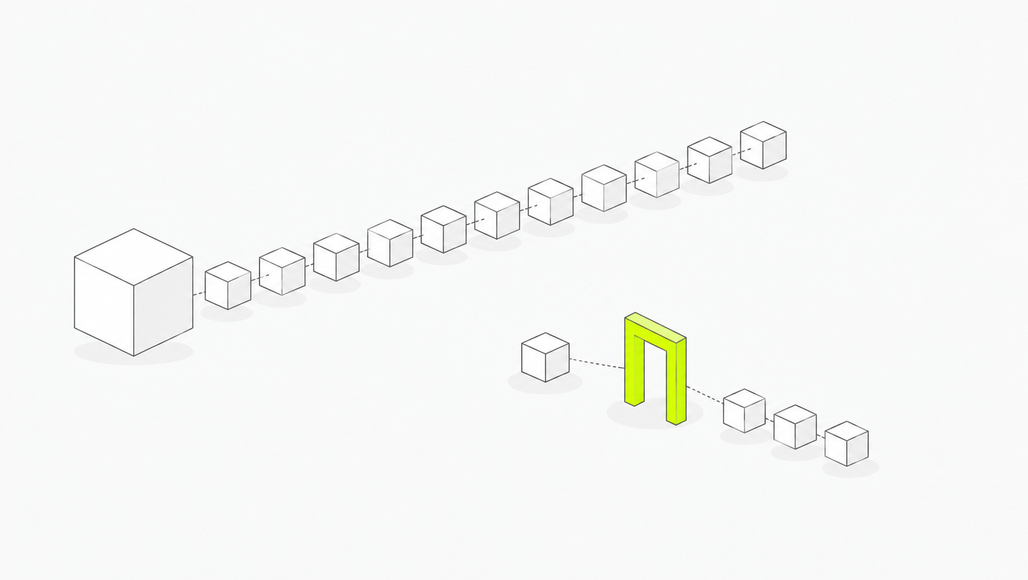
- Action case: specific measures management can approve, with dates and owners.
Do not improve runway by moving a cost outside the model. If a payment remains necessary, show when it returns. Do not count unsigned funding as cash. Show it as a scenario dependency with a decision deadline.
A worked cash, forecast and runway scenario
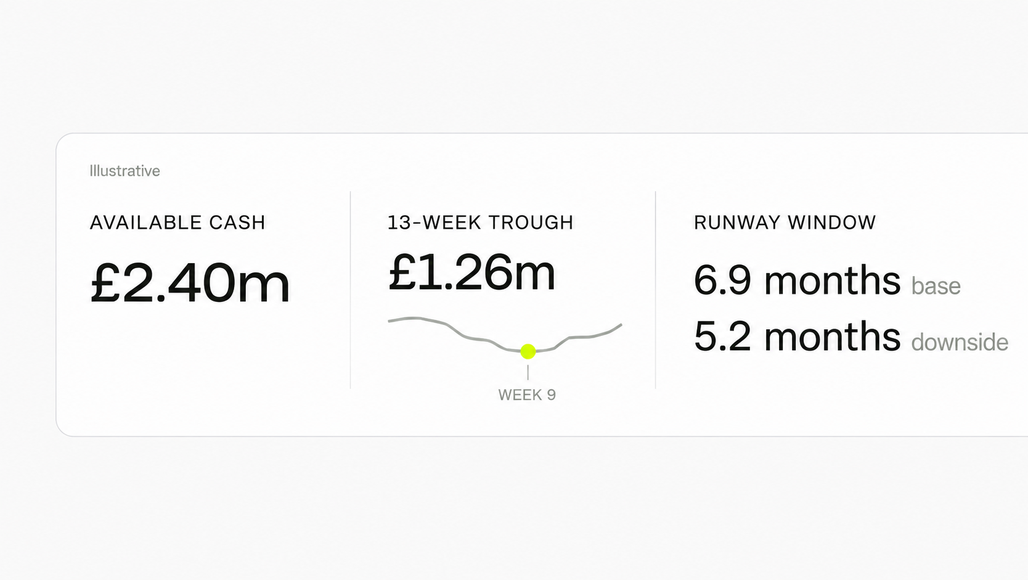
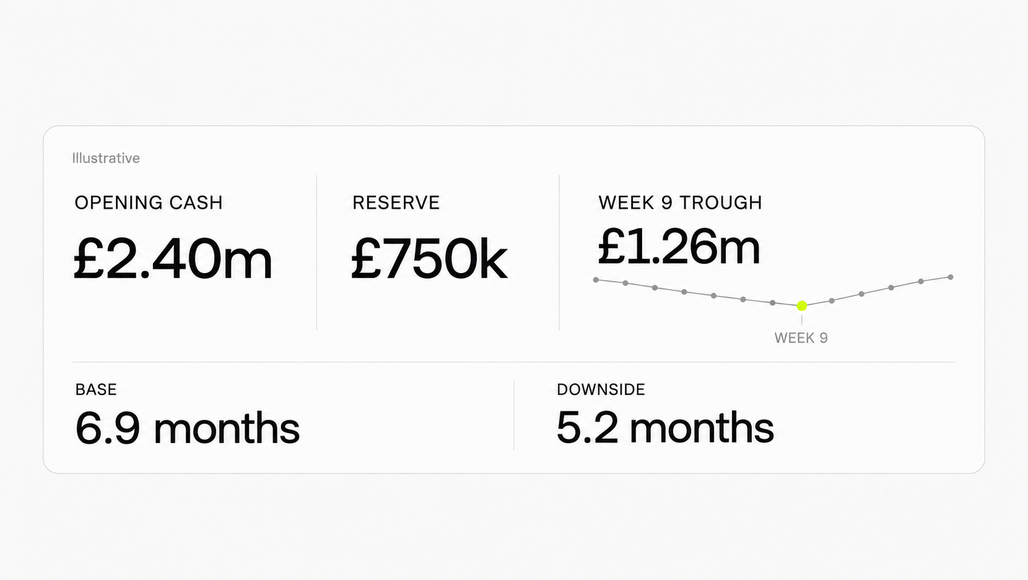
This example is illustrative. Assume a scale-up has £2.40 million of cleared, unrestricted operating cash and a board-approved minimum reserve of £750,000.
The 13-week base forecast reaches a low point of £1.26 million in week nine after payroll, an annual software renewal and VAT. The plan then recovers as contracted customer receipts settle.
The current balance alone suggests comfort. The weekly forecast identifies the week-nine trough. The runway scenarios show that approving £450,000 of growth spend reduces the downside decision window by about six weeks.
Finance can now frame a decision:
- approve the spend only after specified receipts clear;
- split the commitment into milestones;
- set a fundraising date before downside runway falls below the board threshold; or
- identify cost actions that can be executed without harming essential operations.
Run the control weekly in 2026
Put statutory and contractual dates into the forecast as dated cash flows. As checked on 24 September 2026, monthly PAYE is generally due by the 22nd of the next tax month when paid electronically.
An online VAT return and payment are usually due one calendar month and seven days after the accounting period. Corporation Tax should usually be paid nine months and one day after the accounting period ends. Confirm the company's actual dates and payment method in its HMRC account.
Use a fixed operating rhythm:
- Daily: reconcile material bank movements and availability changes.
- Monday: refresh collections, payment proposals and the 13-week low point.
- Midweek: challenge low-confidence assumptions with their owners.
- Friday: lock the forecast, record variances and circulate decisions.
- Monthly: refresh runway scenarios against the approved operating plan.
- At triggers: escalate immediately rather than waiting for the next cycle.
This management control does not replace a formal going-concern assessment. The FRC's going-concern guidance supports all UK companies except small companies and micro-entities, which have separate guidance.
When should the board be involved?
The Insolvency Service says insufficient cash is one of the most significant factors in company failure, even when the company is trading effectively. Escalation should therefore follow defined triggers, not judgement made under pressure.
- forecast headroom falls below the minimum reserve;
- payroll, tax, debt service or a critical supplier payment may be missed;
- a funding dependency moves later than the last safe decision date;
- a material receipt loses evidence or confidence;
- an entity cannot fund its own obligations; or
- the downside case shows no credible corrective action.
The Insolvency Service says a company is insolvent when it cannot pay bills as they fall due or its debts exceed its assets. If the company becomes insolvent, directors' priorities shift from shareholders to creditors. Directors should seek qualified legal and insolvency advice promptly rather than relying on a forecast alone.
Our view: choose the model that changes decisions
We build Round as an agentic finance operating layer that connects treasury, accounts payable and related finance work. Automation prepares, reads and surfaces exceptions; named humans retain consequential approval.
A well-controlled spreadsheet may be enough for one entity, one bank and predictable flows. A connected control becomes more valuable when finance must reconcile several entities, banks, currencies, ledgers, payment approvals and scenario decisions.
Before adopting any system, run one test. Can the CFO trace the headline runway number back to today's available cash, each material 13-week flow and the exact management assumptions that change the decision?
If the answer is no, adding another dashboard will not solve the problem. Rebuild the control around one position, one forecast and explicit decision dates.
Sources
- IFRS Foundation: IAS 7 Statement of Cash Flows
- Insolvency Service: Director information hub, cashflow
- ICAEW: Liquidity management for businesses at times of stress
- ICAEW: Cash flow forecasts and inventory
- ICAEW: Financial management
- Financial Reporting Council: Guidance on the Going Concern Basis
- HMRC: Pay employers' PAYE
- HMRC: Sending a VAT Return
- HMRC: Company Tax Return obligations
- Insolvency Service: Director duties upon insolvency
- UK Government: Financial Model Essentials
- Round Treasury: General Risk Disclosure
Nothing within this blog is intended to be a recommendation. Round does not offer financial advice.
Frequently Asked Questions
No. The 13-week forecast maps dated receipts and payments week by week. Runway extends the plan into scenarios and estimates when available cash reaches a defined reserve or another decision threshold.
Update material balances daily and refresh the full controlled position at least weekly. Increase the frequency when headroom is tight, collection timing changes or a major payment depends on a transfer or approval.
Show available borrowing separately from cash. Include it in a funding view only after confirming the facility limit, conditions, expiry, draw process and any covenant or approval dependency.
Exclude cash that cannot fund the operating plan. Show it separately so the total reconciles to bank and accounting records without overstating the amount available for payroll, suppliers or growth decisions.
Finance should own the control, but operating leaders should own their assumptions. Sales owns collection and pipeline inputs, people teams own hiring dates, and budget holders own committed spend and corrective actions.
No. The budget expresses the approved plan. The cash control translates that plan into settlement timing, liquidity pressure and decision dates, then feeds evidence back into the next reforecast.
Seek qualified advice promptly if the company may be unable to pay obligations when due, downside actions are not credible or directors are unsure how financial distress affects their duties.