






























How Payroll Automation Works for UK Scale-Ups in 2026
 Copied!
 For a UK finance lead weighing automated payroll, the mechanism splits cleanly: software handles file capture, HMRC reporting, funding and payment execution, while a named person still checks the numbers and signs off every run.
For a UK finance lead weighing automated payroll, the mechanism splits cleanly: software handles file capture, HMRC reporting, funding and payment execution, while a named person still checks the numbers and signs off every run.
This guide follows a payroll run from file to payment, showing where automation works and where a human still looks.
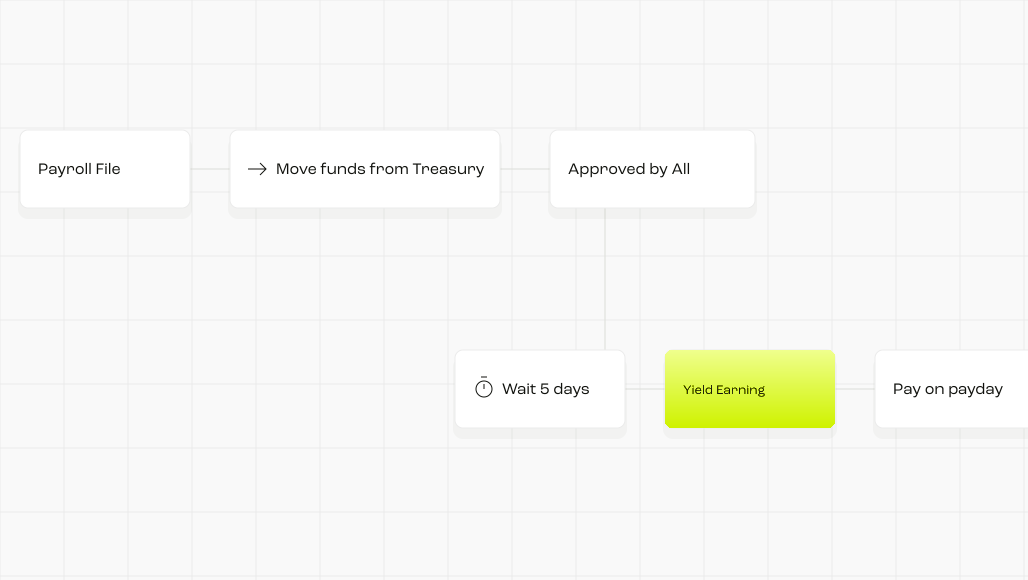
It also covers payroll funded from a treasury balance that can earn yield until the money is due.
TL;DR
- A Full Payment Submission (FPS) reports pay and deductions to HMRC and must reach HMRC on or before payday, every payday.
- Auto-enrolment does not stop at hiring. Every pay period, reassess who newly qualifies and keep contributions at the 8% minimum (3% employer, 5% employee) on the 2026/27 qualifying-earnings band.
- Most UK payroll runs on Bacs, a fixed three-day cycle: submit, process, funds land. Miss the cut-off and the run slips a working day.
- Automation removes manual chasing, mapping and re-keying. It does not remove the person who approves the run or answers to HMRC for what was filed.
- Where an enabled plan supports it, payroll can be funded from a treasury balance that earns yield while it waits. That is a funding mechanism, not payroll calculation.
- HMRC-recognised software, including Xero Payroll, Sage and PayFit, all file the same RTI reports. The differences sit in plan entitlement, workforce support and what each tier bundles in.
See how funding payroll from a treasury balance works in practice: our payroll product.
What happens between uploading the payroll file and the money landing?
An automated payroll workflow breaks the job into the same stages. Products differ in which stage they own.
- Calculation. A payroll engine, such as Xero Payroll, Sage or PayFit, or an accountant using HMRC's own tools, works out gross pay, tax, National Insurance, student loan deductions and statutory pay, and produces a payroll file.
- Capture and mapping. The automation platform reads that file and maps each line to a funding rule: which account, which entity, which cost centre.
- Approval routing. The run goes to the named approver, or approvers on a threshold ladder, with a reminder if nobody has signed off close to the deadline.
- Funding and execution. Funds reach the payment rail in time for the chosen rail's cut-off and settlement timetable.
- HMRC reporting. An FPS goes to HMRC on or before payday. An EPS follows where the business needs to reclaim a statutory payment or has not paid anyone in a tax month.
- Ledger sync. The payment, the deduction and the RTI submission are written back to the accounting system, so reconciliation does not start from a gap.
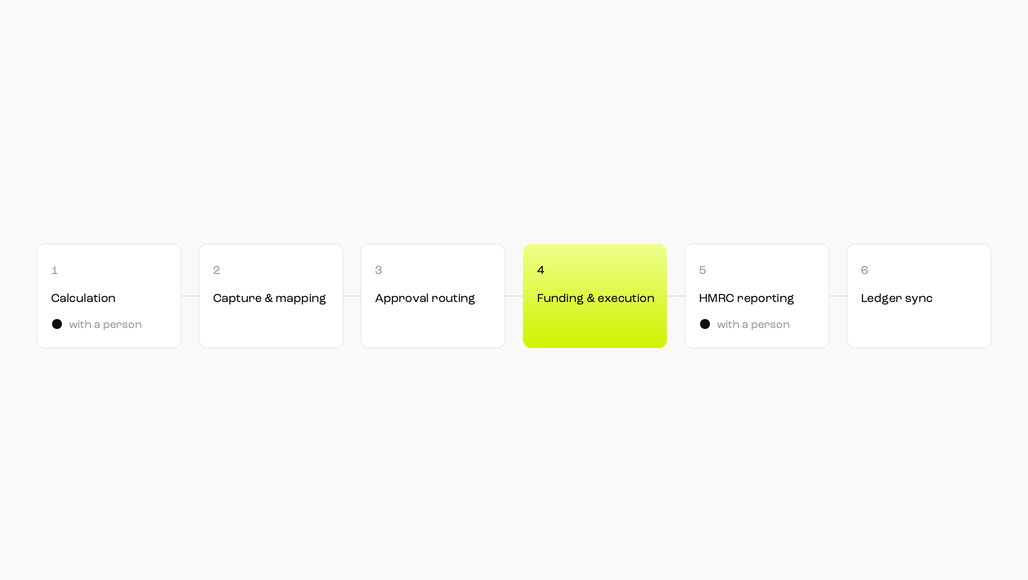
Automation changes stages two, three, four and six: the repetitive, rule-based work software is good at. It does not touch stage one unless the same product also runs payroll end to end, and it should not remove stage five's human check. A wrong FPS is the employer's problem with HMRC, not the software's.
How does automated payroll report to HMRC, and what happens if it is late?
Real Time Information, or RTI, is the reporting framework, not a single report. Two documents sit inside it:
- Full Payment Submission (FPS): reports pay and deductions for everyone paid, due on or before payday, every payday, whatever the pay frequency.
- Employer Payment Summary (EPS): sent instead of an FPS if nobody was paid in a tax month, and alongside it to reclaim statutory maternity, paternity or adoption pay, claim the Employment Allowance, or reclaim Construction Industry Scheme deductions. Due by the 19th of the following tax month for HMRC to apply the reduction.
Late reporting is not a formality. HMRC can issue a late filing notice and penalty, and a new employer sending no report within 120 days can have the PAYE scheme closed.
In payroll calculation software, RTI filing can follow a completed pay run. A separate payment executor does not thereby submit the FPS for you. Responsibility for a wrong or missing submission still sits with the employer, not the vendor.
Who checks pension auto-enrolment, and when?
Auto-enrolment is not a box ticked once, at hiring. Every pay period, the employer reassesses who newly qualifies as earnings, hours or age change, and keeps contributions moving for anyone already enrolled.
- Assessment runs every pay period, not only at hiring, because a pay rise or a change in hours can move a worker into or out of qualifying-earnings status.
- Minimum contribution for 2026/27 stays at 8% of qualifying earnings: 3% employer, 5% employee including tax relief, on a band of £6,240 to £50,270 a year.
- Ongoing duties do not end at the staging date. The Pensions Regulator can ask an employer to make up any contribution shortfall if it decides there were no reasonable grounds for the certification used.
This is where payroll automation reduces risk rather than saving typing time. Reassessment at calculation catches a status change; relying on memory can produce the missed enrolment The Pensions Regulator later asks about.
Which payment rail moves the money, and what are the cut-off times?
Bacs is still the default rail for routine UK payroll, and it runs on a fixed three-day cycle regardless of which software submits the file.
- Day one: the file is submitted, subject to whatever earlier cut-off the bank sets, commonly mid-afternoon rather than the scheme's own later limit.
- Day two: processing.
- Day three: funds clear into the employee's account.
- Faster Payments moves money in minutes and is the rail for anything urgent, but it carries the fraud checks and occasional holds that come with same-day transfers.
Weekends and bank holidays do not count, so a cut-off missed before a bank holiday weekend can delay payday by several days, not one.
Automating the run does not change the rail's physics. It helps get the file ready and approved before the cut-off, rather than finished at the deadline under pressure.
What does automated payroll take off a person's desk, and where does a human still sign off?
The boundary sits in one place: automation prepares, reads and routes. A named person still approves anything that spends money or reports to a regulator.
Automation reliably does:
- Mapping a payroll file to funding rules and entities.
- Chasing and reminding approvers, escalating automatically if someone is away.
- Preparing and submitting FPS and EPS reports where the chosen calculation software supports them, subject to validation and deadline checks.
- Executing the payment on the scheduled rail.
- Syncing the payment and deduction back to the ledger.
A person still owns:
- Calculating gross pay, tax and statutory pay in the first place, unless the same platform does that too.
- Approving the specific run before money leaves the business.
- Deciding what happens to a flagged exception, such as a leaver paid twice or a changed bank detail.
- The correctness of what HMRC receives, whatever software sent it.

That split is why "automated payroll" and "payroll with no person involved" are different claims. An employer that removes the approval step entirely has not automated payroll. It has removed a useful approval control; the employer remains responsible for the filing and payment.
What is different about payroll that pays itself from a treasury balance?
We do not calculate salaries or tax. Your payroll provider or accountant does that. Where Salary Payments is enabled for your plan, we take its file, map it to funding rules, route approvals and schedule payment in time for the chosen rail.
The difference is where money sits before it moves. Cash in a non-interest-bearing current account earns nothing between funding and payday. Salary Payments links funding to a treasury balance, subject to plan availability, fund timing and payment-rail deadlines.
- You drop the payroll file in; it maps the data to your funding rules and preps the run.
- Approvals route to the named approver automatically, days before the deadline, not at it.
- The balance is monitored continuously; a shortfall alerts you days before the execution deadline.
- Once the withdrawal and rail cut-offs have both been allowed for, funds move to the payment rail and the run executes on its chosen timetable.
- Multi-entity businesses run separate approval chains and funding per entity from one consolidated view.
Availability check: our payroll page describes Salary Payments, while parts of our pricing page label Payroll Payments as coming soon. Confirm availability, plan entitlement and the funding timetable with us before relying on this workflow.
We are Round Financial Limited, authorised and regulated by the Financial Conduct Authority under reference number 1050315. We are not a bank, and the balance behind payroll sits with regulated partners, not our own balance sheet, in funds such as BlackRock's money market products. Your capital is at risk while it sits there: it is invested, not deposited, and a money market fund's value can go down as well as up.
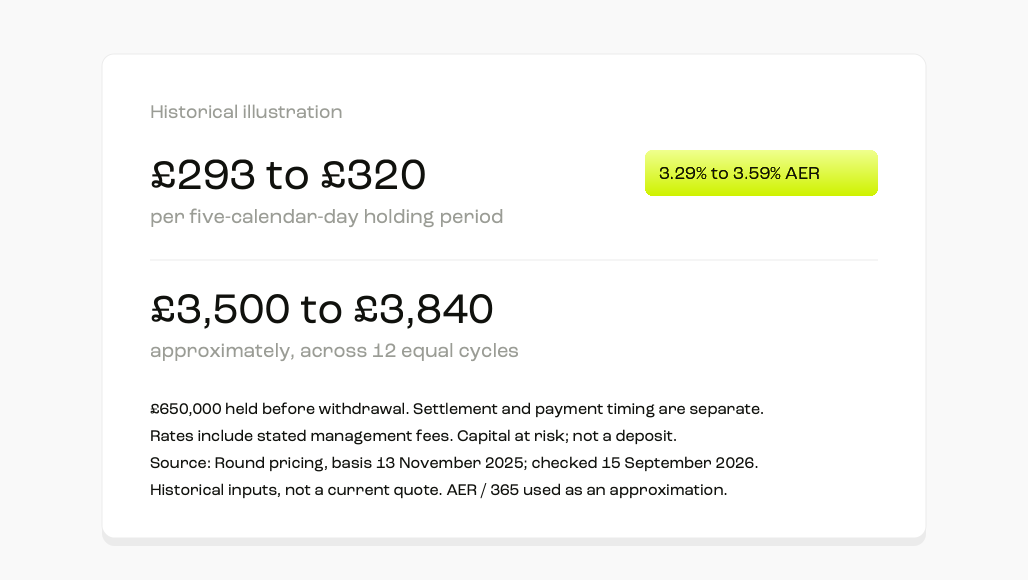
Put a number on it: a business paying £650,000 a month that funds the account five calendar days before withdrawal for payroll, with settlement and the payment rail allowed for separately, holds that balance somewhere for those five days regardless of platform.
- Payroll value: £650,000 a month.
- Time invested before withdrawal: 5 calendar days.
- Illustrative yield: 3.29% to 3.59% AER, historical figures shown on our pricing page when checked on 15 September 2026, with a rate basis dated 13 November 2025. They are illustration inputs, not current verified rates or guarantees. They reflect the stated 0.6% and 0.3% annual management fees; returns vary, other charges can apply, and the rates are not available on every plan or balance.
- Qualifier: this is a money market fund investment, not a deposit, so capital is at risk.
Using annual rate ÷ 365 as a simple short-period approximation, five calendar days of yield is £650,000 × 3.29% to 3.59% ÷ 365 × 5, or roughly £293 to £320 depending on the plan. Across twelve cycles on the same buffer, that is around £3,500 to £3,840. Model the net rate, not a fund factsheet's gross figure. Funding payroll only shortly before the required withdrawal earns close to nothing this way.
This only helps if the money would otherwise sit idle. A business that already sweeps its operating account into an interest-bearing facility overnight gains little from moving payroll funding into a treasury balance too.
How does this compare with running payroll through Xero, Sage or PayFit?
All three are HMRC-recognised: verified to submit PAYE information in the correct RTI format, not an endorsement of one over another.
- Xero Payroll: Grow, Comprehensive and Ultimate include 1, 5 and 10 employees respectively. Additional employees cost £1.50 a person a month. Confirm workforce support for your organisation with Xero before committing.
- Sage Payroll: obtain a current provider quote and confirm whether the P11D and CIS work you need is included in the proposed tier.
- PayFit: obtain a current provider quote and confirm employee support and the P11D automation included in your plan.
The published product pages checked on 15 September 2026 do not describe a treasury-funded payment feature for these three services. That is a scope difference, not proof that no integration can support it. They calculate and file payroll. What we add sits after their output: taking the file, funding it from treasury, and paying it, whichever engine or accountant produced it.
What should you check before trusting a payroll system with a live run?
- Does the provider appear on HMRC's recognised software list, checked for the current tax year, not assumed from memory?
- Who answers if an FPS is late or wrong: vendor, accountant, or you? In UK law, it is the employer.
- Does auto-enrolment reassessment run every pay period, or only at hiring?
- What happens to a flagged exception, such as a leaver paid twice? Does it hold for a person, or pay anyway?
- If money is funded from a treasury balance, is that balance a deposit or an investment, and what happens to it if the platform fails?
- What is the real cut-off time your own bank sets for the rail you use, not the scheme's published maximum?
Where does automated payroll fit, and where does it not?
Where we would put ourselves: we fit a business already running, or wanting to run, treasury, payables and payroll funding through one place, that would otherwise leave payroll cash idle for several days before each run. A single-entity business with a stable headcount and payroll funded only shortly before its required funding date has less to gain, because there is little idle time to earn on.
A dedicated calculation engine, Xero Payroll, Sage or PayFit, fits any business first, whatever else it uses, because something has to calculate the pay and file RTI reports. The case against us is plain: we do not calculate salaries, so a business also keeps one of those, or an accountant, regardless.
A useful test: work out how many days pass between funding payroll and paying it, and what that balance currently earns. If the answer is zero, this mechanism will not change much for you.
About the author
Pac O'Shea is Co-Founder and CEO of Round. His work focuses on how finance teams move from manual, informational tools to controlled, auditable automation.
Sources
Frequently Asked Questions
An FPS reports pay and deductions for everyone paid that period and is due on or before payday. An EPS is sent instead when nobody was paid in a tax month, or alongside an FPS to reclaim statutory payments or the Employment Allowance, due by the 19th of the following tax month.
No. Automation removes repetitive mapping, chasing and reporting work. A named person still approves each run, verifies the pay figures unless the platform also calculates them, and answers for what HMRC receives.
Every pay period, not only when someone is hired. Earnings, hours and age can move a worker into or out of qualifying-earnings status between runs.
Bacs still runs on a fixed three-day cycle regardless of which software submits the file. Automating the run improves how early and reliably the file reaches the cut-off. It does not change how long the rail itself takes.
No. Where the balance sits in a money market fund rather than a plain deposit, your capital is at risk and the value can go down as well as up. Allow for the fund withdrawal and payment-rail cut-offs before relying on it for payroll.
Not as far as their published product pages describe, as at 15 September 2026. They calculate pay and file RTI reports. Funding from a yield-bearing balance is a separate mechanism layered on top, which is what we add.
The whole three-day cycle moves to the next available working day, so a missed cut-off before a weekend or bank holiday can delay payday by more than one day.
The employer, not the software provider. HMRC can issue a late filing notice and a penalty regardless of which platform sent it.