































Multi-currency treasury for UK scale-ups: a 2026 framework for FX, netting and fewer logins
 Copied!
 A dedicated EUR or USD account should earn its place through local receiving details, avoided conversions and reconciliation work. There is no universal monthly-volume threshold. For a UK scale-up expanding into the EU or US, this guide covers account choice, currency netting and consolidating logins.
A dedicated EUR or USD account should earn its place through local receiving details, avoided conversions and reconciliation work. There is no universal monthly-volume threshold. For a UK scale-up expanding into the EU or US, this guide covers account choice, currency netting and consolidating logins.
TL;DR
- Open a local-currency account when its total cost and receiving details fit your actual flows. A free or low-cost account can make sense at modest volumes if it avoids repeated conversions. [1][4]
- Net your exposure first: pay a USD or EUR bill from currency you already hold before converting anything, and only convert the leftover balance.
- A forward contract locks in a future rate, but it locks you into that trade too. It suits a large, dated payment whose amount is sufficiently certain.
- Safeguarded e-money is not the same as an FSCS-protected deposit. Check which one actually holds your balance; the answer can differ even within one provider's own product range. [6][11][13]
- Compare currency providers on the full cost stack, the reference rate plus the spread plus the fee, not the headline percentage alone. Ours is priced by plan, not by one flat number. [1][2]
- A single login only counts as consolidation if the platform nets and reports across currencies; a dozen dashboards behind one password is not consolidation.
Holding GBP, EUR and USD in one place, with netting rules you set yourself: see how our multi-currency accounts work.
When does a local-currency account make sense?
Three things decide it: volume, frequency and counterparty count, not the number of currencies your invoices happen to mention.
Run the check against your own numbers before opening anything:
- Volume. Compare the conversions you would avoid with account fees and reconciliation time. A £15,000 to £20,000 monthly flow is an example to model, not a sourced break-even rule. [4]
- Frequency. A one-off USD payment for a conference sponsor does not justify an account; a US contractor invoice arriving every two weeks does.
- Counterparty count. One recurring EUR supplier is easier to manage from a GBP account than several EUR counterparties on different terms. Model the time saved alongside fees; neither count is a universal tipping point.
- Direction of flow. If you only ever pay in a currency and never receive it, a local account mainly saves you the conversion spread. If you both receive and pay in it, the bigger saving is netting, covered next.
None of this is about how many currencies your product happens to touch. A scale-up billing five EU countries in euros needs one EUR account, not five.
How do you net GBP, EUR and USD exposure instead of converting everything twice?
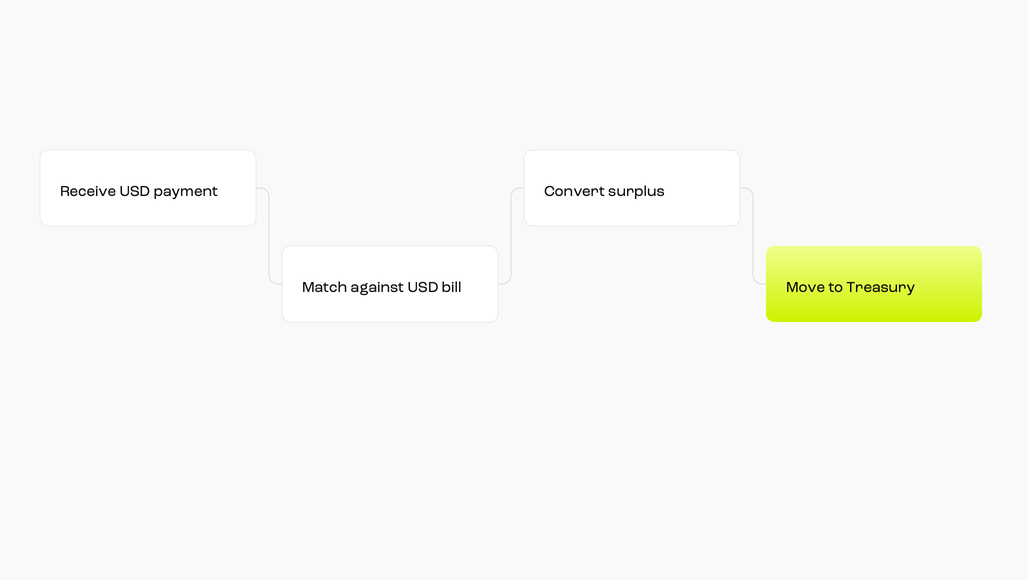
Natural netting means paying a bill in the currency you already hold, before converting anything to or from GBP. It sounds obvious once stated, and it can prevent a needless second conversion.
Here is the pattern that costs money: USD lands from a customer, gets converted to GBP the same day, and three days later the same team converts GBP back to USD to pay a US contractor. Two conversions, two spreads, on money that never needed to leave USD at all.
The fix: hold the USD, pay the USD bill directly from it, and only convert whatever is left over once both sides of the flow have been matched. The order to check for netting candidates:
- A recurring bill in a currency you also collect revenue in (a US contractor paid from US customer receipts).
- A subsidiary's local costs paid from that subsidiary's local revenue, before any group-level sweep.
- A supplier who will invoice in your home currency if you ask, removing the exposure entirely rather than just netting it.
- Only after the first three: the genuine leftover balance that has to be converted, because there is no offsetting flow for it.
What netting is worth on a real month
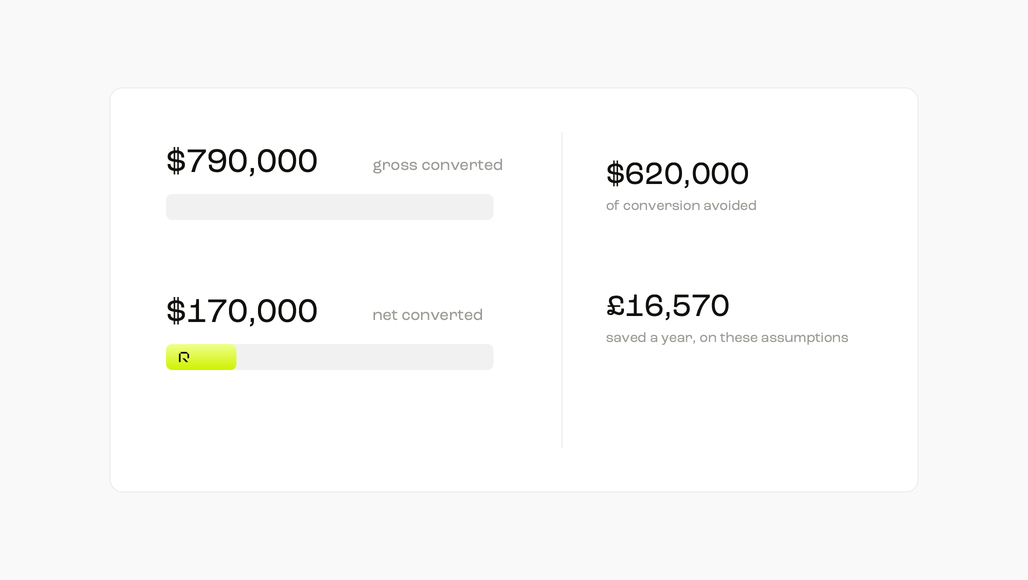
Take a UK scale-up collecting $480,000 a month from US customers and paying $310,000 a month to a US contractor and US-subsidiary costs. The arithmetic, assumptions labelled:
- Without netting. Convert both flows independently through GBP: $480,000 + $310,000 = $790,000 of gross converted volume for currency exposure that is really only $170,000.
- With netting. Pay the $310,000 bill straight from the USD received, then convert only the leftover surplus: converted volume drops to $170,000, a $620,000 reduction.
- Fee avoided. At our Growth-plan FX fee of 0.30% (verified 2026-09-15), that $620,000 reduction is $1,860 a month.
- In pounds. Using an illustrative GBP/USD conversion assumption of 1.3474, not a current quote, that is roughly £1,381 a month, or about £16,570 a year, saved by netting first rather than converting both flows separately. [2][20]
That does not include the extra spread a high-street bank typically adds on top of its own reference rate, independently reported at roughly 2% to 4%, against roughly 0.5% to 1% at a fintech provider. [21] Route either flow through a bank account instead of a dedicated multi-currency account and the netting saving widens further.
If the $170,000 surplus sits in a yield-bearing treasury balance while it waits to be used, that balance carries capital at risk and is not FSCS protected; it is not a guaranteed return.
What is a forward contract, and why might your business not want one yet?
A forward contract fixes an agreed exchange rate today for a payment on a future date. The forward rate can differ from today's spot rate, including because of the currencies' interest-rate difference. It removes the risk that the rate moves against you before then, in exchange for giving up any upside if the rate moves in your favour.
It suits a business with a large, contractually certain, dated payment: a fixed supply contract, a property purchase, a known acquisition instalment. It is a poor fit for most scale-ups because:
- Volumes are still changing. A forward locks a specific amount on a specific date; a growing business's actual USD or EUR need three months out is usually a forecast, not a fact.
- It is a commitment, not a tool you can walk away from. Cancelling or adjusting a forward before it settles can itself cost money if the rate has moved.
- Most banks and providers want a minimum ticket size, often tens of thousands of pounds equivalent, and sometimes a credit line or margin arrangement behind it.
- It solves the wrong problem for many teams. Netting removes exposure entirely for money you both receive and pay in the same currency; a forward only manages exposure you cannot net away.
The honest order to work through: net what you can, hold the rest in the currency you will need it in where possible, and only reach for a forward once a payment is large, dated and certain enough that the commitment is worth it.
Where does the money sit, and is it protected?
We are Round Financial Limited, directly authorised and regulated by the FCA, FRN 1050315. The protection of a balance depends on the product and underlying institution, not our brand name. [2]
This is the question most multi-currency guides skip, and it is the one that matters most if a provider fails. Every category below is labelled, not just the one your business happens to use.
Two things follow from this table. First, "Revolut" is not one answer: whether a given Revolut Business account is FSCS-protected depends on whether it has migrated to Revolut Bank UK Ltd or still sits with the e-money entity, and the only way to check is the entity name on your own statement footer. [12][13][14]
Second, safeguarding is a real protection, but it is not equivalent to FSCS cover: it relies on ring-fencing being done correctly and can take longer to pay out if a firm fails. [16] Treat "our money is safeguarded" and "our money is FSCS protected" as different claims, because they are.
What costs money when you convert currency?
Three things stack on top of each other, and a headline percentage usually names only one of them:
- The reference rate. The mid-market rate (what you'd see on a currency converter) is the honest baseline. A rate quoted "from" a bank's own screen is often already marked up before any separate fee is added.
- The spread. The gap between the reference rate and the rate you're actually given. This is where most of the real cost hides, especially at a high-street bank.
- The fee. A stated percentage or flat charge on top of the rate you're given.
Here is what each of the three companies most often compared for this job actually publishes, checked on 2026-09-15:
- Wise charges a conversion fee "from 0.24%, varying by currency pair," against the mid-market rate, with volume discounts on larger monthly totals. [5]
- Airwallex charges 0.5% above interbank on major currencies (including GBP, USD and EUR) and 1.0% on others, with custom pricing available by agreement. Do not apply another region's volume threshold to a UK quote. [9]
- Revolut Business charges a 0.6% markup once a plan's fee-free monthly allowance is used, with a separate 1% surcharge outside market hours (Friday 17:00 to Sunday 18:00 New York time). [14][15]
- We price FX by plan rather than one number: 0.50% on Launch, 0.30% on Growth, and "as low as" 0.10% on Enterprise. A separate page on our own site headlines a flat 0.10% rate, which is what Enterprise pays but not what Launch or Growth pay, so confirm the rate on your actual plan before assuming either published figure applies to you. [1][2]
None of these four is "the cheapest," because the answer depends on your currency mix, your monthly volume and which plan or tier you would actually sit on. Ask each provider for the rate on your real volume before comparing headline numbers.
How do payment rails and cut-off times affect a GBP, EUR or USD move?
The rail your money travels on decides when it actually arrives, and it is a different answer for each currency:
A local currency account with local receiving details (an account number and sort code, an IBAN, or US routing details) lets a counterparty pay you on their own domestic rail, which is usually faster and cheaper for them than an international transfer into a foreign account. This is the operational reason a local account can be worth opening even before the netting math alone justifies it. [4][8]
How many currency logins is too many, and how do you consolidate them?
The complaint is rarely "we have money in three currencies." It is "we have three separate portals, three separate exports, and nobody has one number for the group's real position."
A dozen logins under one password manager is not consolidation. What actually reduces the problem:
- One place that reads every connected balance, so nobody is manually pulling six exports into a spreadsheet before a board meeting.
- A conversion rule when your provider makes it available, so a recurring surplus does not sit waiting for someone to remember to convert it. Confirm that the rule, controls and plan entitlement are live before depending on it. [1][2]
- One approval flow across currencies, so a EUR payment and a GBP payment go through the same review, not two different systems with two different habits.
- Journals that post automatically to your accounting system, so consolidating currencies does not create a second, manual reconciliation job to replace the first one.
Our public pages describe connected balances, conversion and integrations. They also give conflicting availability labels for FX and payroll automation. Confirm whether automatic conversion, Xero or NetSuite posting, and any agent function are enabled on your plan before relying on them. [1][2]
When should a UK scale-up choose Round Treasury, and when should it look elsewhere?
Where we would put ourselves: choose Round Treasury when you want your GBP, EUR and USD accounts, your netting rules and your accounts-payable and payroll funding running from one workspace, subject to confirming the automation functions and plan entitlements available to your business.
Consider Wise when its published multi-currency holding, local account details and conversion pricing match your transfer requirements. [4][5]
Consider Airwallex when its published local account details in 15+ countries and its UK fee model match your collection and payment needs. [8][9]
Consider Revolut Business only after checking the exact account entity, plan allowance and product features you would use. Its protection status depends on that entity, not the brand name. [11][12][13]
The case against us, stated plainly: our public pages give conflicting availability labels for FX automation, so confirm live scope before relying on it; GBP, USD and EUR are the published core currencies, with others on request; and a business that needs forwards, options or a layered hedge programme should assess a specialist treasury desk platform.
If any of those is your actual job, one of the other three is the better starting point today.

About the author
Pac O'Shea is Co-Founder and CEO of Round. His work focuses on how finance teams move from manual, informational tools to controlled, auditable automation.
Sources
- Round Treasury, FX
- Round Treasury, Pricing
- Round Treasury, multi-currency online payment platform
- Wise Business
- Wise, pricing
- Wise Help Centre, how our UK entity Wise Payments Ltd safeguards customer funds
- FCA Register, Wise Payments Limited
- Airwallex, Global Accounts (UK)
- Airwallex, pricing (UK)
- The Paypers, Airwallex granted EMI licence by the FCA
- FCA E-Money Firms register (CSV), cross-referenced for Revolut Ltd
- Sifted, Revolut finally wins UK banking licence after five-year tussle
- CrowdfundInsider, Revolut Launches Full UK Banking Services With FSCS Protection
- BusinessExpert.co.uk, Revolut Business Review 2026: Fees, Plans and FSCS Status
- Statrys, Revolut Business Account Review 2026
- Financial Conduct Authority, FSCS Protection for E-Money and Payment Institution Customers?
- Pay.UK, Faster Payment System
- Nordea, cut-off times (SEPA credit transfer)
- Federal Reserve Financial Services, Wholesale Services Operating Hours (Fedwire)
- TradingEconomics, British Pound
- PaulBeare, Fintech vs UK High-Street Bank Accounts
- Nacha, Same Day ACH schedules and funds availability
- Financial Services Compensation Scheme, deposit protection limit
- Pay.UK, How Faster Payments work
- European Central Bank, instant payments
- Wise Group plc, Full Year 2026 Financial Results
- Businesswire / Airwallex newsroom, Series H funding and scale metrics
Frequently Asked Questions
No. Open one where recurring flows, local receiving details and avoided conversions justify account fees and reconciliation work. There is no universal monthly-volume threshold; use your own fees and workload.
No. Netting matches money you already receive against money you already owe in the same currency, which removes exposure rather than managing it. Hedging (a forward contract, for example) manages exposure you cannot net away, at the cost of a binding commitment.
It depends entirely on which entity holds it. A safeguarded e-money account, the model most multi-currency fintech accounts use, is not FSCS protected. A deposit at a fully authorised bank entity is, up to £120,000 for eligible deposits. Check the entity name on your statement, not the brand name on the app.
Our public FX page describes automated hedging while pricing labels the FX Agent "soon." Treat automated hedging and agent availability as unconfirmed until we confirm the enabled functions and plan entitlements for your business. [1][2]
Three things: the reference rate a provider starts from, the spread it adds to that rate, and any separate fee on top. A low headline fee next to a marked-up reference rate can cost more than a transparent mid-market rate with a slightly higher fee.
Only for the specific amount and date it covers. It also removes the upside if the rate moves in your favour, and most providers set a minimum size and may want a credit line behind it, so it suits a large, certain, dated payment better than ongoing operating flow.
No, and it can make it worse. Consolidation comes from one platform that reads every balance, nets and reports across currencies and posts to your accounting system automatically, not from adding another separate portal for each new currency.
GBP, USD and EUR as core currencies with published pricing; additional currencies are available on request. Confirm current coverage before assuming a specific currency is supported out of the box. [1]