






























How Real-Time Cash Flow Visibility Across Multiple Banks Works
 Copied!
 How finance teams get one real-time view of cash across every bank, entity and currency with Round Treasury: the fragmented-data problem, the technical steps behind automated consolidation, and what good multibank visibility software should provide.
Real-time cash flow visibility across multiple banks means connecting every account through secure Open Banking APIs and normalising the data into one format.
TL;DR
- Cash scattered across multiple banks is a growing risk, and the guide explains why.
- It is specific about who actually needs automated multibank visibility, and who does not.
- It defines what real-time honestly means in 2026, rather than using it as a slogan.
- It walks through how automated multibank consolidation works and what good looks like for a finance team.
- Approaches are compared side by side, including how Round gives one live view across every bank and entity.
Why cash scattered across multiple banks is a growing risk
Most finance teams do not choose to fragment their cash. It happens gradually: a UK operating account, a savings account for a cash buffer, a local bank for a new EU entity, and sometimes a card or spend platform layered on top.
Each new bank relationship solves one problem and creates another. Whoever has to answer “how much cash do we actually have right now” ends up logging into every portal separately, exporting a statement, and pasting the numbers into a spreadsheet.
By the time that spreadsheet is finished, some of the balances in it are already stale. A payment has cleared, a transfer has landed, or a currency has moved, and the group cash position on screen no longer matches the group cash position in the banks.
That gap matters most at multi-entity companies, where cash has to be split by legal entity and currency, not just totalled. A UK holding company with an EU subsidiary and a US sales entity cannot answer “what is our runway” from a single bank login, because no single bank holds the whole picture.
Currency adds another layer. A group holding GBP, EUR, and USD balances across different banks cannot compare them meaningfully without converting to one reporting currency first, and a manual process usually only does that conversion once a week or once a month, not as exchange rates move.
Who actually needs automated multibank cash visibility
Not every company needs a dedicated platform for this. A single-entity business with one main bank account can usually manage with that bank’s own app. The need for automation shows up once a few specific patterns appear:
- More than two or three bank accounts across current, savings, and spend platforms.
- More than one legal entity, whether a subsidiary, a holding structure, or an entity in a second country.
- Balances held in more than one currency.
- A weekly or monthly cash report that takes hours to compile because it starts from separate bank exports.
Once two or more of these apply, the manual process stops scaling and the case for a consolidated, real-time view gets straightforward.
What “real-time” actually means for multibank cash visibility in 2026
“Real-time” gets used loosely in finance software marketing, so it is worth being precise. A genuinely real-time system pulls balances and transactions as they post, not once a day at close of business.
The alternative, an end-of-day batch file or a manually refreshed export, is not wrong. It is simply a different product: one that shows a finance team where cash was yesterday, not where it is now.
For most operational decisions, current-day accuracy is what actually matters: deciding whether to release a large payment, checking whether a sweep into a savings account has landed, or confirming a subsidiary has been funded before a payroll run. Yesterday’s number cannot answer any of those questions safely.
How automated multibank consolidation actually works
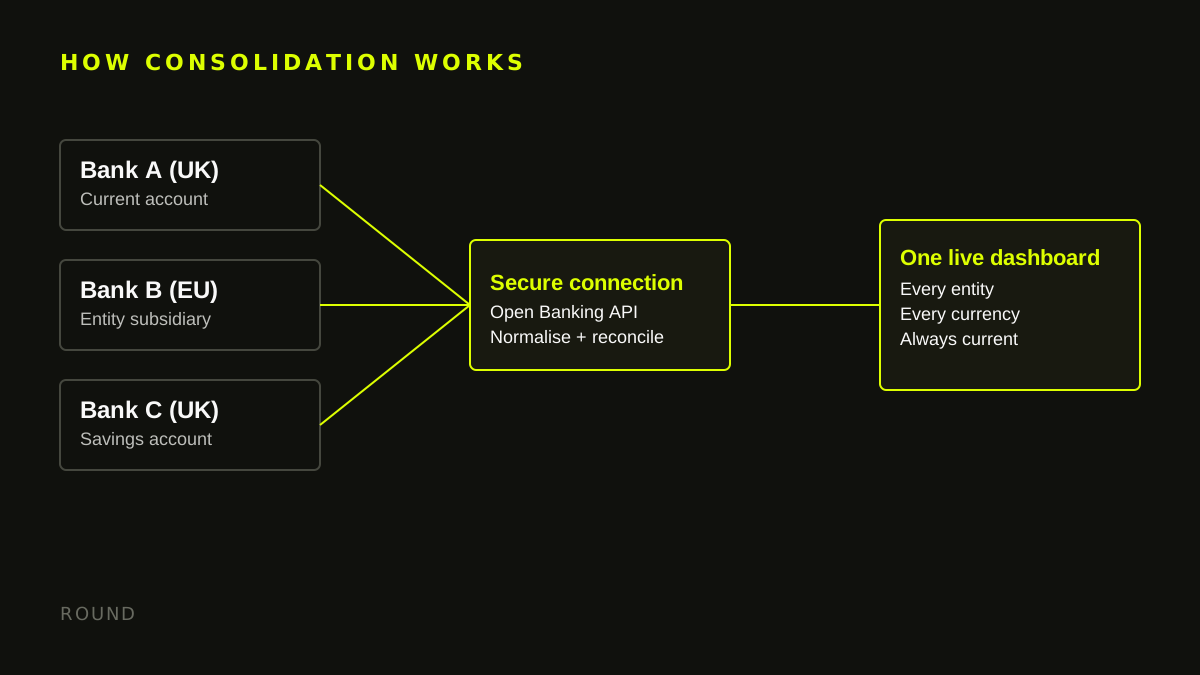
Consolidating cash across banks is a data problem before it is a dashboard problem. Four steps have to happen, in order, before the number on screen can be trusted.
Step 1: Connect every account through secure, regulated APIs
The first step is connecting each bank account through Open Banking or an equivalent regulated API, rather than screen-scraping a login page. In the UK, third parties must follow the API standards set by Open Banking Limited, and must be authorised by the Financial Conduct Authority to request read-only access to balances and transactions.
This matters for security as much as for automation. A regulated API connection does not store the bank login itself, access is read-only unless a payment permission is separately granted, and it can be revoked from the bank’s own app at any time.
Step 2: Normalise balances and transactions into one data model
Every bank formats its data differently. One might return a balance in pence, another in pounds; one labels a transfer “FPS,” another labels the same transfer type something else entirely.
Before any of that data is useful, it has to be normalised: converted into one consistent format, tagged by entity, account, and currency, and reconciled against what was expected. This is the step most manual spreadsheet processes skip, which is exactly why they drift out of date.
Step 3: Build a live dashboard by entity, currency, and account
Once the data is normalised, it can be rolled up into a single dashboard: total group cash, cash by entity, cash by currency, and cash by individual account, all built from the same underlying numbers.
A finance team managing three entities across two currencies should be able to see the group total and drill into any one entity or bank account without switching tools or re-exporting a statement.
Step 4: Set thresholds and alerts so nothing slips through
The last step turns a dashboard from something people check into something that checks itself. Balance thresholds, large-transaction alerts, and low-balance warnings mean a finance team finds out about a problem the moment it happens, not the next time someone happens to log in.
A normalised, continuously updated dataset also creates a usable audit trail. Once every balance and transaction sits in one consistent format, it is far easier to reconcile a month-end close or answer an auditor’s question than when the same data is scattered across a dozen exported statements.
What good multibank cash visibility should give a finance team
A consolidated view is only useful if it actually removes work rather than moving it into a new tool. At minimum, it should provide:
- One login that shows every connected bank account, not a separate export per bank.
- Balances broken down by legal entity, not just a single group total.
- Multi-currency totals shown in a common reporting currency, alongside the local balances.
- Transaction-level drill-down, so a large or unexpected movement can be traced back to its source account.
- Configurable alerts for low balances, large transfers, or accounts that stop refreshing.
Cash visibility approaches compared
There is no single right way to track cash across banks. The approach that makes sense depends on how many accounts, entities, and currencies a finance team is managing.
Manual consolidation still has a place for very small companies with one bank account and a simple structure. It stops working the moment a second entity, a second currency, or a second bank enters the picture, because the time it takes to compile a group position grows with every account added.
Any consolidation approach, automated or not, is still only as good as the accounts it actually covers. A platform that connects most of a group’s banks but misses one local subsidiary account will show a confident number that is quietly wrong, so bank and country coverage is worth checking before relying on any dashboard for a real decision.
How Round gives finance teams one live view across every bank and entity
Round’s multi-entity solution follows the same four steps above: it connects UK and EU bank accounts through Open Banking, normalises the data by entity and currency, and puts it on one dashboard rather than one screen per bank.
The average Round customer consolidates around 80% of group cash into that single view, replacing an average of three separate bank portals with one, and saving finance teams more than four hours a week that used to go into manual cash positioning.
The underlying connection covers over 2,000 UK and EU bank accounts, so most groups can bring every entity into the same dashboard rather than leaving one or two out. Exact account and entity limits depend on plan; current tiers are listed at roundtreasury.com/pricing.
Round's roadmap extends this into an agent layer: a planned Cash Positioning Agent, listed as coming soon on the pricing page, would work from the same consolidated, real-time balances to flag funding gaps or surplus cash across entities, with any recommended movement still gated behind a human approval step before money moves.
That matters because consolidated balance data is sensitive by definition: it shows exactly how much cash a group holds and where. Round holds ISO 27001 certification for its information security management, and connections run through regulated Open Banking access rather than stored bank credentials.
For a finance team managing more than one entity, that combination, real-time visibility plus an agent that recommends actions without executing them unsupervised, is the practical middle ground between a static dashboard and full automation. See how Round links all your bank accounts and the multi-entity solution for more detail.
The underlying test is simple: can someone answer “what is our group cash position right now, by entity and currency” in under a minute, without opening a spreadsheet or a second banking app. If the answer is no, that is the gap automated multibank visibility is built to close.
Related reading
Frequently Asked Questions
Each bank account is connected once through a regulated Open Banking API, and the balances and transactions are normalised into one format, tagged by entity and currency, then rolled up into a single live dashboard. That removes the need to log into each bank separately or rebuild the group total in a spreadsheet.
It means balances and transactions update as they post, not once a day in an end-of-day batch file. For most UK finance teams that matters most around payment releases, confirming a sweep or transfer has landed, and checking a subsidiary is funded before payroll runs, all of which need a current-day number rather than yesterday's.
Connecting every account to a consolidated cash visibility platform through Open Banking replaces the separate logins with one dashboard. The trade-off is that the dashboard is only as complete as the accounts actually connected, so it is worth confirming every entity's banks are included before relying on it day to day.
Look for balances broken down by legal entity and currency (not just a single group total), transaction-level drill-down, configurable low-balance and large-transfer alerts, and clear bank and country coverage. Coverage matters most: a platform that misses even one local subsidiary account will show a confident group number that is quietly wrong.
A consolidated multibank dashboard pulls balances from every connected account through Open Banking and totals them by entity, currency, and the group as a whole, updating continuously rather than on a manual refresh. Round's multi-entity solution works this way, connecting UK and EU bank accounts into one real-time view.