




























How Slack bill approvals should work
 Copied!
 A practical control model for approving bills from Slack without confusing a chat response with payment authority or losing the accounting evidence.
Slack bill approvals work when Slack is the decision surface, not the accounting record or the payment rail. The approver should see a stable bill summary, act within a verified authority limit and create a durable decision in the finance system. Payment should move only after that system rechecks the bill, the policy and any exceptions.
TL;DR
- Use Slack to present and capture a decision, while the finance system remains the system of record.
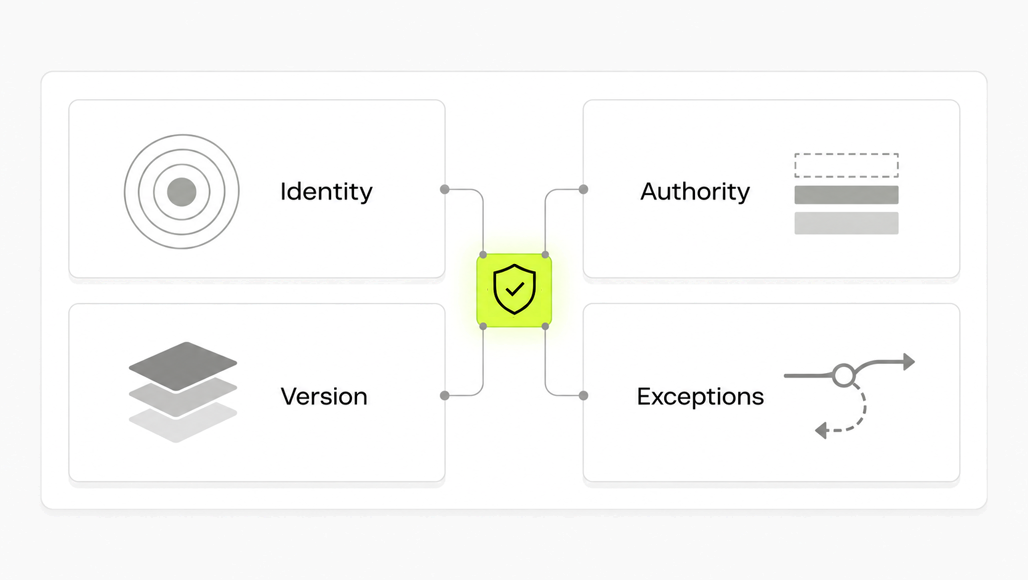
- Bind each action to a named user, bill version, legal entity, amount, currency and approval policy.
- Invalidate approval after a material bill or supplier change. Never let an old response authorise a new payment.
- Separate approval from payment release, then record who or what released the payment and under which conditions.
- Design for expired requests, duplicate clicks, revoked access, missing evidence and integration failure before launch.
- Match retention and audit evidence to the finance record, not to the life of a Slack message.
What changes when a bill approval moves into Slack?
The decision becomes easier to reach, but it also crosses a system boundary. In a conventional workflow, the bill, policy check, approval and audit history may all sit in one finance product. With a Slack approval, the user sees a representation of that bill in a separate collaboration tool. The control design has to prove that the representation and the underlying record still match.
That distinction matters. A quick approval can remove waiting time from accounts payable. A casual message, copied emoji or stale notification can also create the appearance of control without the evidence behind it. The aim is not to turn a finance process into chat. It is to let the right person decide in the place they already work while the financial system keeps responsibility for identity, versioning, release and reconciliation.
A useful starting point is to separate three things that are often bundled together:
- Notification: telling somebody that a bill needs attention.
- Approval: recording an authorised decision against a specific bill version.
- Execution: funding, scheduling and releasing the payment through the appropriate system.
A notification does not grant authority. An approval does not have to release funds immediately. Execution should not assume that the earlier conditions remain true. Treating those as separate states gives finance teams room to stop, recheck or escalate a payment without losing the speed of an in-workflow decision.
Which system should hold each part of the record?
Slack can make a decision visible and convenient. It should not become the only place where evidence lives. Slack says that retention settings vary by plan and workspace policy, and that retained message history can be limited or deleted.[5] Its full audit-log capability is also plan-dependent.[4][6] That is useful operational context, but it is not a substitute for an application-level approval record tied to the bill.
This model follows a broader SaaS principle: use role-based access, least privilege, multi-factor authentication where available, and retained activity logging for privileged actions. Those are among the controls in the NCSC’s guidance for using SaaS securely.[7][12] Slack itself provides administrative roles and security controls, but the finance application still needs to decide whether a Slack identity is allowed to approve this bill at this moment.
What information should an approver see?
An approver should be able to decide without opening six tabs, but brevity must not remove the facts that change the answer. A well-designed approval card normally needs:
- supplier legal name and a stable supplier identifier;
- the legal entity that will pay;
- invoice number, amount, currency and due date;
- purchase order or contract match where relevant;
- whether bank details are new or changed;
- duplicate, fraud, sanctions or policy flags;
- the applicable approval threshold and current step;
- a link to the bill and supporting evidence in the finance system.
Do not paste full bank details or sensitive invoice attachments into a broad channel. Show only what the approver needs and keep the protected record behind the finance application’s access control. The Slack action should carry an opaque request identifier rather than treating visible text as the authoritative instruction.
How do you stop a stale approval releasing a changed bill?
Version the request. When a Slack card is created, the finance system should store a fingerprint of the bill state that matters to the decision. If the supplier bank account, amount, currency, entity, due date or supporting evidence changes, the fingerprint changes and the earlier request expires.
This is the difference between approving a bill version and approving a supplier in the abstract. It also closes a common exception path: somebody approves a legitimate invoice, then a bank-detail change arrives before payment. The original decision should not travel across that change.
What should happen after someone clicks approve?
The first response should be a validation, not a transfer. The connected system should validate permissions on every request.[9] For this workflow, recheck the user’s active identity, role, authority limit, segregation requirements, bill version and outstanding exceptions, and reject repeat actions deterministically. If two approvers click at nearly the same time, the second response should see that the request has already changed state.
Then the workflow can decide whether the bill is ready for the next approval, ready to schedule, or held for investigation. The record should make that outcome explicit. “Approved” is not enough if the payment later failed, was cancelled, was released by a different person or never reached the ledger.
Which failure states need an explicit route?
Good workflow design is mostly exception design. A finance team should decide what happens when the simple path stops being simple. At minimum, test:
- Expired request: the action returns a clear status and a route to the current bill.
- Revoked access: removing a user or role blocks any outstanding Slack request immediately.
- Threshold breach: an approver cannot authorise above their current limit, even if the message was addressed to them.
- Changed supplier details: the payment stops and bank details go through the organisation’s independent verification process.
- Integration outage: the user sees that no decision was recorded, rather than a reassuring but false success message.
- Duplicate action: a repeated click is idempotent and does not create a second payment or approval.
- Missing evidence: the request moves back for information instead of encouraging approval from an incomplete summary.
- Separation conflict: the person who created or edited the supplier cannot approve where policy requires a different actor.
For firms within the FCA’s operational-resilience rules, the wider process may also sit inside mapping and testing of important business services. The FCA’s current guidance describes identifying important services, setting impact tolerances, mapping dependencies and testing the ability to remain within those tolerances.[8] That does not make every Slack approval a regulatory workflow. It does mean an in-scope firm should understand the dependency it has introduced.
What does a complete audit trail look like?
The most useful record reads as an event chain. It should be possible to reconstruct what the system knew and why each state changed.[10][11] Store:
- request identifier, bill identifier and bill-version fingerprint;
- supplier, paying entity, amount, currency and due date at decision time;
- the policy evaluated, required approval steps and authority result;
- Slack workspace and user identifiers mapped to the finance user;
- request, view, decision and expiry timestamps;
- approve, reject, return or escalate outcome and any reason code;
- exceptions present, how they were resolved and by whom;
- payment schedule, release actor, payment identifier and final status;
- ledger or ERP reference after reconciliation.
Slack’s Enterprise audit logs can help security teams review organisation-level events and app activity, and Slack documents CSV, JSON and API access for those logs.[4] That is complementary evidence. The bill-level chain still belongs with the financial record because it needs fields that collaboration-platform logs may not contain.
How should you evaluate software that offers Slack bill approvals?
Start with a live control demonstration, not a screenshot of an approval button. Give the vendor a test bill, change a material field after the request is sent, remove the approver’s access, click twice and interrupt the integration. Ask to see the resulting audit record after each event.
Where does Round fit?
Our current pricing page lists Slack integration, Slack notifications, approval rules and routing, workflow history and audit-log capabilities across plan descriptions. It separately marks advanced approval rules and routing as coming soon.[1] Our supplier-payments material describes a connected path from invoice capture through approval, payment and reconciliation, while the launch article identifies phased early access for selected teams.[2][3]
Those details mean a buyer should confirm the exact configuration, plan and availability they need. The control model in this guide is broader than a feature claim. Whether you use Round or another platform, the practical test is the same: a decision made in Slack should strengthen the path to an authorised payment, not detach the decision from its evidence.
For the wider AP mechanism, read how accounts payable automation works. For the boundary between automation and judgement, see what AP automation replaces and what still needs a human. Round’s current pricing and capability page is the place to check product availability before a buying decision.
Is a Slack approval enough to release a payment?
Only if the connected finance system validates the approver, the approval policy, the bill version and the payment conditions before release. A Slack message on its own is not a sufficient payment control.
What evidence should a Slack bill approval retain?
Retain the approver identity, timestamp, bill and supplier identifiers, amount and currency, policy result, bill version, decision, exceptions, payment release identity and final accounting reference. The finance system should hold the durable record.
How should edits after approval be handled?
Any material change to supplier bank details, amount, currency, entity, due date or supporting evidence should invalidate the prior approval and create a new version for review.
Do Slack retention settings affect the audit trail?
Yes. Slack retention varies by plan and workspace policy, so a message may not remain available for the life of the financial record. Copy the decision and its evidence into the finance system at the time of approval.
Which bills should not be approved from Slack?
Route unusual or high-risk cases back to the finance system, including changed bank details, first payments to new suppliers, sanctions or fraud flags, policy overrides, weak supporting evidence and values above the approver's authority.
How should finance teams test Slack approvals before launch?
Use a controlled test set covering valid approvals, rejection, expiry, duplicate action, revoked access, edited bills, changed bank details, missing evidence, threshold breaches and integration failure. Confirm that every outcome appears in the finance-system audit trail.
Sources
- Round, pricing and capability matrix, captured 21 September 2026.
- Round, Supplier Payments, captured 21 September 2026.
- Round, Supplier Payments launch, 10 December 2025, captured 21 September 2026.
- Slack, audit logs, captured 21 September 2026.
- Slack, data retention settings, captured 21 September 2026.
- Slack, plans and features, captured 21 September 2026.
- National Cyber Security Centre, using SaaS securely, captured 21 September 2026.
- Financial Conduct Authority, operational resilience, captured 21 September 2026.
- OWASP, Authorization Cheat Sheet, captured 21 September 2026.
- OWASP, Logging Cheat Sheet, captured 21 September 2026.
- NIST SP 800-92, Guide to Computer Security Log Management, captured 21 September 2026.
- National Cyber Security Centre, identity and access management, captured 21 September 2026.
Nothing within this blog is intended to be a recommendation. Round does not offer financial advice.
Frequently Asked Questions
Only if the connected finance system validates the approver, the approval policy, the bill version and the payment conditions before release. A Slack message on its own is not a sufficient payment control.
Retain the approver identity, timestamp, bill and supplier identifiers, amount and currency, policy result, bill version, decision, exceptions, payment release identity and final accounting reference. The finance system should hold the durable record.
Any material change to supplier bank details, amount, currency, entity, due date or supporting evidence should invalidate the prior approval and create a new version for review.
Yes. Slack retention varies by plan and workspace policy, so a message may not remain available for the life of the financial record. Copy the decision and its evidence into the finance system at the time of approval.
Route unusual or high-risk cases back to the finance system, including changed bank details, first payments to new suppliers, sanctions or fraud flags, policy overrides, weak supporting evidence and values above the approver's authority.
Use a controlled test set covering valid approvals, rejection, expiry, duplicate action, revoked access, edited bills, changed bank details, missing evidence, threshold breaches and integration failure. Confirm that every outcome appears in the finance-system audit trail.