






























How to design treasury Slack alerts that finance teams act on in 2026
 Copied!
 A practical treasury exception policy for Slack: severity, routing, ownership, escalation, context, deduplication and closure.
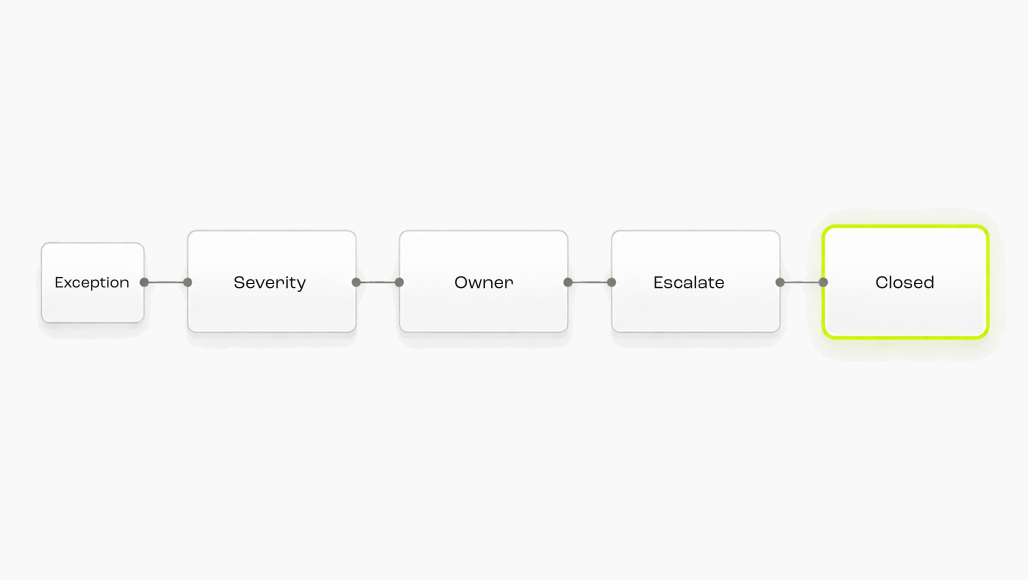
Treasury Slack alerts work when each message names the exception, owner, response deadline and close state. Severity should reflect the decision window and cash consequence, not how dramatic the notification sounds. Slack is the coordination surface. Your treasury or finance system remains the source of truth. An alert is complete only when a named owner resolves, escalates or deliberately closes it with evidence.
TL;DR
- Alert only when a person must act within a defined time window.
- Route by accountable role, with one named owner and one backup.
- Put the trigger, impact, freshness, deadline and next action in the message.
- Escalate on an expired response clock, not on message volume.
- Close every alert with a reason and a durable system record.
What makes a treasury Slack alert actionable?
An actionable alert describes a state that needs a human response. It gives that person enough context to claim the issue and take the next step without reconstructing the event from three systems.
That sounds obvious, but many finance channels mix four different things: information, warnings, tasks and urgent exceptions. Once every balance movement or workflow update arrives in the same format, the channel stops expressing priority.
Google's monitoring guidance makes a useful distinction: immediate issues go to an interrupting route, subcritical work goes to a queue, and informational data stays available for inspection. Treasury teams can borrow that logic without copying an engineering on-call model wholesale. The core question is the same: does a human need to act now, later or not at all?
Set severity from the response window
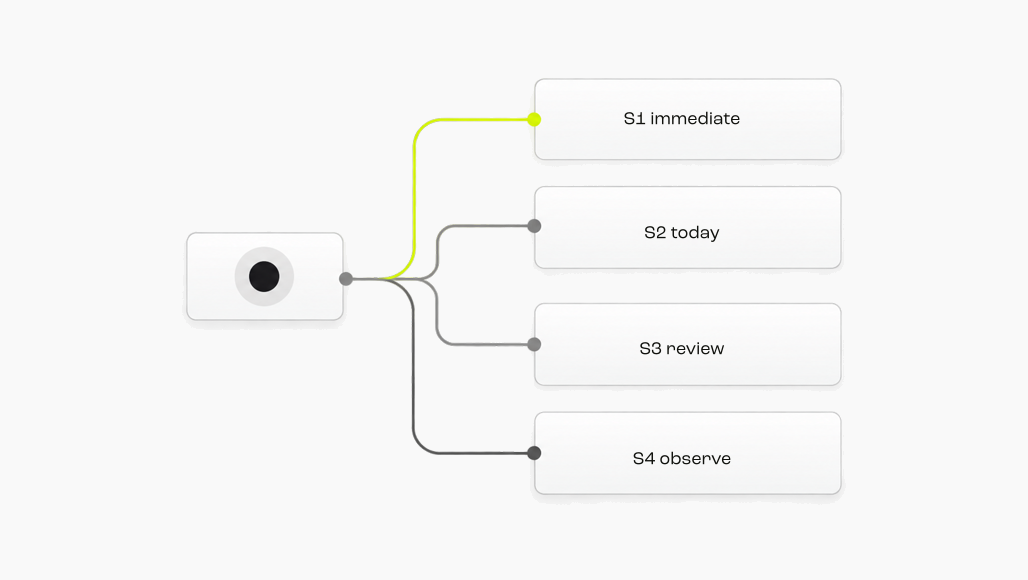
Severity should combine four factors: time to impact, financial consequence, reversibility and data confidence. Avoid an arbitrary cash threshold on its own. A modest shortfall due in two hours can matter more than a large forecast movement six months away.
Start with four response classes and document examples from your own operating model. The labels can change. The action window cannot.
Slack is not a pager. Slack lets individuals pause notifications and set notification schedules. For S1 events, define a second route and a clear handover. A critical policy that depends on every user keeping identical personal settings is fragile by design.
Route to an owner, not an audience
A channel is a place. It is not an owner. Posting to a group without assigning responsibility creates the bystander problem: everyone can see the alert, so nobody knows who must act.
Build routing around accountable roles first, then resolve the current person from your rota or team structure. A sound route has four fields:
- Primary role: the person accountable for the first response.
- Named owner: the person on duty for that role now.
- Backup: the next person if the response clock expires.
- Escalation owner: the person who decides when the issue crosses policy boundaries.
Use private messages sparingly. They can wake the right person, but they hide shared context and make handover harder. A strong pattern is a channel alert with an explicit mention, then a private or secondary route only when severity or elapsed time justifies it.
Ownership also covers the workflow itself. Slack documents workflow managers as the people permitted to edit and manage a workflow. Finance teams should separately name an operating owner for the alert policy and a technical owner for the integration. One person can hold both roles in a small team, but the responsibilities should still be explicit.
Put the decision context in the first message
An alert should answer the first questions a treasury operator asks. What changed? Compared with what? Which entity or account is affected? How fresh is the data? When does the decision become costly? What should I do next?
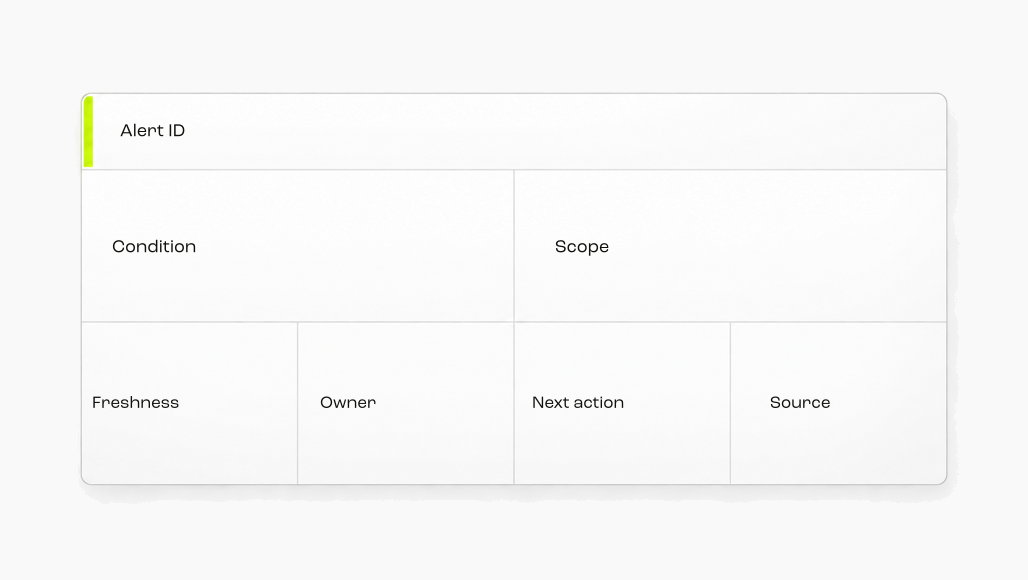
Use a fixed message contract so the reader does not have to learn a new layout for each workflow:
- Alert identity: a stable event ID and a plain description.
- Condition: actual value, policy threshold and direction of breach.
- Scope: affected entity, account, currency and obligation.
- Freshness: source timestamp, last successful refresh and confidence note.
- Response: owner, action window and next useful step.
- Evidence: a deep link to the system record, never a pasted secret.
- Suppression key: the identity used to group repeats.
The source timestamp matters as much as the balance. An alert based on stale bank data can create exactly the wrong urgency. If freshness falls below the policy threshold, label the issue as a data-quality exception rather than presenting an old figure as a current cash position.
Keep the payload narrow. The ICO's data minimisation principle says personal data should be adequate, relevant and limited to what is necessary. Apply the same discipline to all sensitive finance context: enough detail to triage, with the full record behind an authenticated link.
Escalate on time and state
Escalation should respond to an expired promise or a worsening condition. Reposting the same message every five minutes increases noise without changing responsibility.
Define the clock for each severity and start it when a valid alert is created. Then escalate on a small set of state changes:
- The alert remains unclaimed when the acknowledgement window expires.
- The owner marks it blocked and names the missing input.
- The underlying condition breaches a higher severity threshold.
- The data source fails, so the team can no longer verify the condition.
- The promised resolution time expires without a close state.
Acknowledgement is not resolution. It means one person has taken responsibility for the next update. The alert should show who claimed it and when the next status is due. That keeps the channel useful during handovers and prevents several people running the same investigation.
For out-of-hours coverage, define what deserves interruption before the first event. Slack's notification controls mean an urgent message can still wait behind a personal schedule. Your policy should specify the fallback route, duty handover and maximum time before the backup is contacted.
Closure is part of the alert design
Many alert systems focus on detection and treat closure as an afterthought. That leaves channels full of unresolved warnings and prevents the team from learning whether thresholds were useful.
Use a short lifecycle that both people and systems can recognise:
- New: created, valid and not yet claimed.
- Investigating: owned, with the next update time recorded.
- Waiting: blocked on named data or another team.
- Resolved: the condition has cleared and the evidence is linked.
- False positive: the trigger fired but no response was needed.
- Accepted exception: an accountable owner chose to tolerate the condition until a stated time.
Every close action needs a reason code, owner, timestamp and evidence link in the durable record. Slack threads help people coordinate, but Slack's own Workflow Builder FAQ says its workflow activity log cannot currently be exported. Do not make a collaboration thread your only long-term operational record.
Closure data is also your tuning set. A high false-positive rate points to a poor threshold, missing persistence window or stale source. Repeated accepted exceptions suggest the written policy and real operating tolerance have drifted apart.
Reduce noise before asking for faster responses
Alert fatigue is usually a design failure, not a discipline failure. If operators ignore alerts, inspect the signal quality and routing before asking them to pay more attention.
Google's practical alerting guidance describes aggregation, persistence windows, deduplication and routing by severity. Those techniques translate well into finance operations:
- Deduplicate: group repeated events with the same entity, account, rule and time window.
- Add persistence: alert only when a condition lasts long enough to matter.
- Use hysteresis: close at a different threshold from the one that opened the alert, which prevents flapping.
- Suppress known windows: account for planned maintenance and expected data delays.
- Group causes: send one parent exception when several symptoms share the same source failure.
- Move information out: put non-actionable changes in a dashboard or digest.
Review a small monthly scorecard: alerts created, percentage claimed inside policy, median time to claim, percentage escalated, false-positive rate, reopened alerts and oldest unclosed item. These are operating measures, not performance targets to optimise blindly. A team can make response time look excellent by closing useful alerts too early.
How Round fits this policy in 2026
Our current product pages describe Slack alerts when finance work needs attention, including examples such as low balances and funding gaps. Our pricing page also lists Slack notifications and workflow run history in the workflows and AI agents matrix.
Availability needs careful qualification. The pricing page marks some adjacent builder capabilities as coming soon, and our April 2026 announcement describes the Agentic Workflow Builder as early access with select customers. Before adopting this policy, confirm the exact event coverage, plan, Slack route, workflow history and export behaviour for your configuration.
This guide therefore separates the operating policy from the product implementation. You can decide severity, ownership, escalation and closure before choosing how each rule is configured. That also makes the policy portable if your bank, ERP or treasury stack changes.
For broader workflow context, read our startup treasury automation playbook. For the system-level view, see how AI-orchestrated treasury management works. This article stays narrower: it defines what happens after a treasury exception deserves human attention.
Test the policy before relying on it
Run the policy as a tabletop exercise before connecting live exceptions. Choose one event from each severity class and walk it through the full route.
- Trigger: prove the condition opens once, with the right source timestamp and suppression key.
- Route: prove the current owner and backup receive the right context in the right channel.
- Claim: prove one owner can acknowledge responsibility without changing the underlying financial state.
- Escalate: let the response clock expire and verify the secondary route.
- Close: record the outcome, evidence and reason code in the source system.
Then test failure cases: stale data, duplicate events, a missing owner, a paused notification schedule and an integration outage. The strongest alert policy is the one that remains clear when the expected route fails.
Our recommendation: start with two or three high-consequence exceptions, not every available signal. If the team cannot name the owner, action window and close evidence for an alert, keep it in a dashboard until it can.
Sources
- Round Treasury homepage
- Round Treasury pricing and product matrix
- Round Agentic Workflow Builder announcement, April 2026
- Round startup treasury automation playbook
- Slack notification schedules and paused notifications
- Slack guide to creating a workflow
- Slack Workflow Builder FAQ
- Google SRE: Monitoring Distributed Systems
- Google SRE: Practical Alerting from Time-Series Data
- ICO guide to data protection principles
Nothing within this blog is intended to be a recommendation. Round does not offer financial advice.
Frequently Asked Questions
Alert only when a named person must act within a defined time window. Immediate liquidity risk, a forecast breach that changes today's funding decision, stale bank data during a critical window and a failed treasury workflow can qualify. Informational movement belongs in a dashboard or digest.
No. Slack should carry the notification, ownership and discussion. The treasury or finance system should retain the underlying data, event identity, workflow state and durable closure record.
Four levels are usually enough: immediate response, same working day, next review window and digest only. The labels matter less than a clear action window, owner, escalation route and example for each level.
Name an on-call owner and backup, define the event that justifies interruption, and use a second route if the response clock expires. Slack alone is not a paging service because individual notification schedules can pause delivery.
Include an alert ID, condition, actual value against threshold, affected entity and account, source timestamp, data freshness, decision deadline, named owner, next action and a link to the source system. Keep sensitive data to the minimum needed for triage.
Deduplicate repeated events, group related exceptions, add persistence windows, suppress alerts during known maintenance, route lower-severity items to digests and review false positives and ignored alerts every month.
Our current pricing page lists Slack notifications and workflow run history, and our product pages describe alerts for items needing attention. The April 2026 Agentic Workflow Builder announcement describes that builder as early access. Confirm the exact event, plan, workflow and availability with us before relying on it operationally.